How I Rediscovered Enthusiasm in the World of Technology After the Rise of LLMs

When LLMs entered my daily life as a software engineer, my feeling was that you could talk about anything with them, and it seemed like there was a real human being on the other side.

Back in 2022, users would access ChatGPT to ask it anything — including software coding problems (sometimes it worked, sometimes it didn’t, sometimes you had to tweak things a little). Now, in 2026, LLMs like Claude Opus 4.5 make you realize that the code they write is better than that of a senior software engineer.

There was a moment in my life when I said — and I think each of us has thought this at least once — “Will I be replaced by a machine?”, “Will I stop writing code?”, “Will I keep working in this field?”. All these questions were keeping me up at night. I was struggling, and I wasn’t even productive at work anymore.

Until I read a book by Bulgakov — The Master and Margarita. The story is about the Devil visiting Moscow in the 1920s under the Stalinist regime, causing all sorts of chaos and literally driving some prominent figures to the asylum. As you may have noticed, it has nothing to do with the world of technology. So why did it “save” me? Why did I feel the urge to say “thank you” to it?

It was Bulgakov’s imagination and creativity — the way he uses them to describe a communist Moscow and criticize the representatives of the USSR — that made me realize that I too can use my creativity to do something, both at work and outside of it. That I am not a monkey writing the same function 100 times in different contexts. That I am a designer of scalable and maintainable software architectures. And that my value always comes from the knowledge I use to create working software.

What I can say to all my colleagues who have found themselves in the same situation is this: the world changes, so embrace change, and always let enthusiasm guide you in designing software — and try to see the glass as half full.

I wish everyone a positive 2026, under the sign of AI.

Getting Started with Django: Setting Up Your First Django Project

For many developers stepping into backend development with Python, one framework quickly comes up in conversation — Django.

Django is a powerful web framework that helps developers build secure, scalable, and maintainable web applications quickly. From startups to large platforms, Django has proven itself as one of the most reliable backend frameworks in modern development.

But for beginners, the first question is usually simple:

How do you actually start a Django project?

In this tutorial, we’ll walk through the basic steps of setting up a Django project, so you can get your development environment ready and start building.

And if you’re new to backend development, don’t worry — this guide is designed to be simple and practical.

Step 1: Install Python

Before installing Django, you need Python on your system.

To check if Python is installed, open your terminal or command prompt and run:

python –version

Or

python3 –version

If Python is installed, you should see something like:

Python 3.x.x

If not, download and install Python from the official website.

Quick Check for Readers

Before moving on:

  • Do you already have Python installed?
  • Which version are you currently using?

Drop it in the comments 👇

Step 2: Install Django

Once Python is ready, the next step is installing Django using pip, Python’s package manager.

Run this command:

pip install django

After installation, confirm it worked by checking the Django version:

django-admin –version

5.x.x

That means Django is successfully installed.

Step 3: Create a Django Project

Now let’s create your first Django project.

Run the following command:

django-admin startproject myproject

This command creates a project folder with the basic structure needed for a Django application.

Your folder should look something like this:

myproject/
manage.py
myproject/
init.py
settings.py
urls.py
asgi.py
wsgi.py

Each of these files plays an important role in configuring your project.

Step 4: Run the Development Server

Navigate into your project folder:

cd myproject

Then run:

python manage.py run server

If everything is working correctly, you should see something like this:

Starting development server at http://127.0.0.1:8000/

Now open your browser and visit:

http://127.0.0.1:8000/

You should see Django’s welcome page, confirming your project is running successfully.

Your Turn

Did your Django server run successfully?

What message did you see in your terminal?

Step 5: Create Your First Django App

In Django, projects contain apps, which handle specific functionality.

To create an app, run:

python manage.py startapp blog

This creates a new app folder:

blog/
admin.py
apps.py
models.py
views.py
tests.py

Apps help keep your Django project organized and modular.

Why Django is Loved by Developers

Many developers choose Django because it provides:

  • Built-in authentication
  • Admin dashboards
  • Security features
  • ORM database management
  • Rapid development capabilities

In fact, platforms like Instagram, Pinterest, and Mozilla have used Django in parts of their systems.

Final Thoughts

Setting up a Django project is actually much simpler than many beginners expect. With just a few commands, you can have a fully functioning backend framework ready to build powerful web applications.
Once your environment is set up, the real fun begins — creating views, building APIs, designing models, and developing real applications.

Community Discussion

If you’re learning Django or already using it, we’d love to hear from you:

  • What was the first project you built with Django?
  • Do you prefer Django for web apps or APIs?
  • What part of Django was hardest to understand at first?

Let’s share experiences and help new developers get started.

🦓 The Tale of the Humbled Process Engineer — Episode IV: The Audience with the Hyena 🐺

A circular desert tent at dusk, illuminated from within by a table glowing with golden scrolls. Around it, faint silhouettes of animals - a chameleon, a gazelle, and unseen scribes - their shadows stretching outward like converging lines of fate. The atmosphere is solemn, ritualistic, as if a trial disguised as ceremony is about to begin.

Scene 1 — The Prelude: Gathering of Winds

“In Automora, meetings were not held to decide, but to sanctify decisions already made.”

The wind carried whispers across the savanna that morning — a tremor of curiosity and dread.
Word had spread: the Zebra had challenged the reports.

By the time the sun reached its zenith, the herds already spoke in rehearsed tones:
“Surely it was a misunderstanding.”
“Surely he meant to support the process.”
But beneath every polite phrase lurked a question none dared to voice — what happens to those who name the illusion?

Inside the council tent, the Chameleon and the Gazelle were already at work, their movements synchronized like ritual.
Scrolls rustled; ink dried under the lamplight.

“Let’s not make this political,” the Chameleon said, adjusting his hue to a neutral beige.
“Everything is political,” the Gazelle replied, without looking up. Her quill scratched at the parchment — neat, uncommitted lines.

Around them, scribes prepared the Scrolls of Harmony — prewritten notes of agreement ready to be filled in after the meeting concluded.
Each line left space for signatures that would bless whatever outcome the Hyena desired.

Outside, the wind shifted again — a low hum through the banners of Alignment and Momentum.
The savanna seemed to hold its breath.

And somewhere beyond the tent walls, the Zebra walked slowly toward his audience, the weight of conviction in every step.

“In Automora, meetings were not held to decide, but to sanctify decisions already made.”

A circular desert tent at dusk, illuminated from within by a table glowing with golden scrolls. Around it, faint silhouettes of animals - a chameleon, a gazelle, and unseen scribes - their shadows stretching outward like converging lines of fate. The atmosphere is solemn, ritualistic, as if a trial disguised as ceremony is about to begin.Where harmony is scripted before truth can speak. (Gemini generated image)

Scene 2 — The Zebra’s Plea for Reflection

“Reflection, in Automora, was rebranded as resistance.”

The tent smelled of parchment, perfume, and fear.
The Hyena sat at the center table, framed by banners proclaiming Progress in Motion.
His grin gleamed like a crescent moon carved into dusk.

The Zebra stepped forward and placed his scrolls upon the table. He did not bow.
His voice, when it came, was calm—almost tender.

“The reports glow bright, Commissioner, but their light hides shadow. We celebrate milestones we never reached. If we pause—only briefly—to understand the gap, we can build what lasts.”

A hush followed, soft but uneasy.
Some of the scribes froze, their quills suspended in midair, unsure whether to record or to forget.

The Hyena broke the silence with a purr disguised as laughter.

“You fear delay more than failure, dear Zebra. The kingdom cannot eat reflection. It must move.”

From his corner, the Chameleon changed color—now a comforting olive of agreement.

“The Commissioner is right. Progress requires rhythm. Sometimes the music matters more than the melody.”

The Gazelle, poised at her desk, captured only fragments for the official minutes:
Encouragement toward agility … recognition of reflective attitude … appreciation for passion.
Each line gleamed with ambiguity, designed to mean nothing harmful later.

The Zebra looked at the glowing dashboards pinned to the tent wall—perfect charts arcing upward, as if success itself obeyed command.
He saw himself reflected faintly in the glass—striped lines distorted by light.

“You mistake stillness for surrender,” he said quietly.
“But there is no direction without pause.”

The Hyena leaned forward, the grin widening just enough to reveal how sharp diplomacy could be.

“You speak of direction. I speak of survival.”

Around the tent, heads nodded on instinct, not conviction.
Agreement, once again, sanctified misunderstanding.

“Reflection, in Automora, was rebranded as resistance.”

Inside a vast ceremonial tent, the Zebra stands before a semicircle of beasts—the Hyena at the center, the Chameleon and Gazelle nearby.<br>
A single shaft of white light cuts across the Zebra’s stripes, dividing him into shadow and brightness.<br>
Scrolls and dashboards glow faintly behind him, symbols of illusion.<br>
The air is dense with quiet judgment and unspoken fear.Reflection mistaken for delay. (Gemini generated image)

Scene 3 — The Hyena’s Doctrine of Pragmatism

“Pragmatism, when stripped of conscience, becomes a religion of control.”

The Hyena rose slowly, pacing around the table as if marking sacred ground.
The banners above swayed in the wind, their printed slogans whispering like ghosts of intent.

“Let us speak plainly,” he began, voice low, deliberate, hypnotic.
“The kingdom runs on perception. Auditors eat illusions, not bones. Our job is not to bare the ribs of reality, but to serve a feast they find palatable.”

He smiled—not the cruel grin of a tyrant, but the patient smirk of one who believes he understands the world better than those still chasing ideals.

“You see, Zebra, your purity is admirable. But it feeds no one. The herds need stories to graze on. Give them truths too sharp, and they choke.”

The Chameleon’s eyes gleamed. He nodded slowly, echoing the Hyena’s cadence.

“Yes … survival is not deceit. It is adaptation. The savanna changes; we must change with it.”

The Gazelle glanced between them—seeing not philosophy, but opportunity. Her quill hovered over the parchment, recording history’s next doctrine.
She added a flourish at the top: “Guidance from the Commissioner on Sustainable Progress.”

The Zebra listened in silence, though the air around him felt heavier with every word.
He saw how easily the Hyena’s logic spread—how comfort dressed itself as wisdom.

“You mistake illusion for mercy,” the Zebra said quietly.
“It is not the truth that starves them—it is the famine of honesty.”

For the briefest instant, the Hyena’s grin froze.
Then came the laugh—soft, indulgent, predatory.

“My dear Zebra,” he said, “if we fed them honesty, there would be no herd left to protect.”

The Chameleon exhaled in admiration.

“What brilliance. Such balance between ideal and necessity.”

And the Gazelle, sensing where safety lay, added with perfect diplomacy:

“Our strength lies in flexibility, not confrontation.”

The Zebra felt the air around him crystallize—the illusion now complete, sealed by consensus.
He realized that the Hyena’s power was not in the lie itself, but in the beauty with which he told it.

“Pragmatism, when stripped of conscience, becomes a religion of control.”

A dimly lit council tent transformed into a stage. The Hyena stands half in shadow, half in golden light, eyes reflecting twin flames. Behind him, rows of beasts - Chameleons, Gazelles, and others - nod in rhythmic approval, their faces blurred by smoke and dust. The Zebra sits apart, calm but unyielding, his stripes stark against the ambient glow.
The sermon of survival.(Gemini generated image)

Scene 4 — The Verdict of Polite Rejection

“In Automora, exile often began with applause.”

The tent had grown still. The air was perfumed with agreement — the most dangerous scent in Automora.
Minutes before, the Hyena’s monologue had settled like dust; now, every creature waited for the inevitable.

The Zebra stood motionless, his parchments still open before him — his map of rivers that might have healed the kingdom, still untouched.
The Hyena leaned back, teeth glinting through a smile too calm to be kind.

“You are a thinker, Zebra,” he said. “And the savanna needs thinkers — though not always here.”
“Perhaps,” he continued, almost regretfully, “your gifts belong in another savanna … one where ideals still pay rent.”

A ripple of soft laughter followed — nervous, rehearsed, obedient.
The Chameleon was first to rise.

“Commissioner,” he declared, “we will, of course, continue the initiative. I can ensure continuity.”

The Gazelle, sensing her cue, added brightly:
“And I will facilitate the alignment sessions — ensure the message remains consistent.”

The Hyena nodded approvingly, as if generosity had been exercised.
The scribes etched the decision into the Scrolls of Harmony:

“Consensus reached. Strategic continuity assured. Gratitude extended to the Zebra for foundational clarity.”

The Zebra closed his parchments with slow precision.
He bowed slightly — not in submission, but in mourning.
Every motion of grace in Automora was a camouflage of grief.

“Then I wish you coherence,” he said quietly.
“May your rivers never run dry — even if they are painted.”

The Hyena clapped once, gently — a sound that sealed the verdict.
Others followed. The applause spread like rain over stone — soft, meaningless, final.

The Gazelle’s eyes flickered for a heartbeat — pity, perhaps, or fear mistaken for empathy.
The Chameleon avoided looking at him at all.

As the Zebra turned toward the tent’s exit, the Hyena’s voice followed, warm and hollow:

“Thank you for your integrity, my friend. It’s rare — and safer, elsewhere.”

The Zebra paused at the threshold.
Outside, the wind carried the scent of sand and ink — the smell of conclusions written before questions were allowed.

“In Automora, exile often began with applause.”

A grand council tent filled with warm golden light. At its center, the Hyena sits smiling in regal ease, paws folded. The Chameleon and Gazelle stand nearby, radiant in approval, scrolls in hand. In the foreground, the Zebra exits through the open flap, his silhouette framed by twilight. Inside, the audience claps-faces half-hidden by the glow. Outside, the desert wind waits.The applause of dismissal. (Gemini generated image)

Scene 5 — The Corridor of Realization

“Some silences are not born of fear, but of calculation.”

Twilight bled slowly into the camp of Automora.
The banners of Renewal and Harmony fluttered in the faint wind, their fabric frayed, their words already fading into dusk.
Drums beat softly in the distance — the rhythm of celebration that always followed suppression.
Somewhere behind him, the tent of the Hyena glowed with laughter: the sound of victory that did not know it had lost its soul.

The Zebra walked alone along the corridor of tents — the so-called “Avenue of Alignment”.
Each doorway revealed its own theater of contentment: herds gathered around dashboards; scribes copying numbers from one parchment to another; the Chameleon addressing a circle of admirers with that tone of measured optimism that Automora called leadership.

Farther down, the Gazelle stood under a lantern, reviewing her notes.
She looked up when he passed.
For a heartbeat, something unguarded flickered in her eyes — an apology, a warning, or perhaps simple fatigue.
Her quill hovered mid-air.

“You could have said more,” the Zebra murmured.
She lowered her gaze. “And you could have said less.”

Neither smiled.
Both knew that honesty now required discretion — and that discretion had become another word for survival.
She stepped aside, allowing him to pass, and added softly,

“They will praise you tomorrow. That is how they erase you.”

He nodded once and continued into the deepening blue.
The camp grew quieter with every step, as though the illusion itself were settling to sleep.
He felt the strange stillness that follows a storm — not peace, but the weight of understanding.

Perhaps they cannot see, he thought.
Or perhaps they see too clearly and have made peace with blindness.

He stopped at the edge of the plateau where Automora’s lights shimmered below like embers.
The wind pressed against his mane, whispering fragments of the Hyena’s voice — “Your purity feeds no one.”
He closed his eyes.
Somewhere in that laughter, he now heard the echo of warning, not mockery.

For the first time, he sensed the shape of what he must become:
not preacher, not reformer, but witness.
The truth would not be shouted — it would be preserved, quietly, like fire beneath ash.

“Some silences are not born of fear, but of calculation.”

The Zebra walks down a dim corridor of tents at twilight. Lanterns cast long shadows of banners marked Harmony and Renewal. In the distance, the Hyena's tent glows gold; beside one lantern, the Gazelle hesitates, half-turned toward him. The horizon beyond fades into deep indigo.Twilight on the savanna of illusions. (Gemini generated image)

Cliffhanger ⏳

The Zebra stepped out into the evening air.
Behind him, the council tent glowed faintly — the meeting still echoing with polite laughter.
From inside came the muffled rhythm of ritual applause,
the same applause that had followed every illusion dressed as progress.

He paused at the threshold, hearing the Hyena’s voice — calm, almost kind:

“We all serve the same purpose, my friend — to keep the dust from settling.”

The flap of the tent closed behind him.
The savanna was quiet. The horizon bled from gold to gray.
He could smell the faint ink of the Scrolls of Harmony still drying inside.

He turned once more, not in regret, but in recognition.
Every sound, every gesture within that tent had been perfectly rehearsed.
He understood now — he had not attended a meeting; he had witnessed a play.

“If illusion governs the day,” he murmured, “then truth must begin its work at dusk.”

He walked away slowly,
each step leaving a print the wind tried — and failed — to erase.

Philosophical Note 🧠

Automora did not preserve illusion by accident;
it invested in it.
The Hyena understood what the Zebra had not yet accepted:
truth is costly, while illusion pays immediate dividends.
Illusion feeds egos, calms auditors, and keeps the drums of progress beating on schedule.
Truth demands silence, correction, and courage — none of which can be measured on a dashboard.

The Hyena’s laughter was not madness;
it was management.
He ruled through calibration, not cruelty —
knowing that if every creature feared chaos more than deceit,
order would maintain itself without force.
Thus, the system remained stable because it was dishonest in a predictable way.

The Zebra, leaving the tent, began to see that denial in Automora was not a failure of reason
but a form of collective adaptation.
The herds had learned to live within contradiction,
to draw comfort from the very illusions that slowly starved their integrity.

He did not yet know what his role would become —
whether witness, reformer, or exile —
but one realization settled like dusk upon his thoughts:

The greatest strength of illusion is not its beauty, but the number of hearts that depend on it to sleep.

🔖 If you found this perspective helpful, follow me for more insights on software quality, testing strategies, and ASPICE in practice.

© 2025 Abdul Osman. All rights reserved. You are welcome to share the link to this article on social media or other platforms. However, reproducing the full text or republishing it elsewhere without permission is prohibited.

How I Reached Top 8% on Kaggle with a Ridge-XGBoost N-gram Pipeline

Kaggle Playground Series S6E3 — Predict Customer Churn | ROC-AUC 0.91685 | Rank 286 / 3,718

The Problem

Customer churn prediction sounds straightforward — given a telecom customer’s usage history and contract details, predict whether they’ll leave. But the Kaggle Playground S6E3 dataset had 594,000 rows of heavily categorical data where the signal was buried inside combinations of features, not individual columns. Standard approaches plateau quickly here.
My starting point was a LightGBM single model. It was decent — but decent doesn’t crack the top 10%. Getting there required rethinking how the model saw the categorical features entirely.

The Core Insight: Treat Categories Like Text

The breakthrough came from an unconventional direction — NLP. In text classification, n-grams capture phrase-level patterns that individual words miss. The same logic applies to categorical feature combinations.

A customer with Contract: Month-to-month is one signal. A customer with Contract: Month-to-month + InternetService: Fiber optic + PaymentMethod: Electronic check is a completely different risk profile — and that combination is what predicts churn.

So I treated categorical columns like tokens and generated bigrams and trigrams across high-impact features: Contract, InternetService, and PaymentMethod. Each unique combination became a new feature, capturing interaction patterns that a standard feature matrix would miss entirely.

Feature Engineering Pipeline

Step 1 — N-gram Categorical Interactions
For each high-signal categorical column, I generated pairwise (bigram) and three-way (trigram) combinations across the feature space. This produced a set of composite interaction features that encoded relationship patterns directly into the model input.

Step 2 — Nested Target Encoding
Raw target encoding leaks — if you encode a categorical feature using the target mean, the model sees information from the row it’s predicting. The fix is nested k-fold encoding: encode each fold using only the other folds’ target statistics. I used a nested 5-fold stratified scheme applied to both the original categorical features and the new n-gram features.

Step 3 — Service Stack Analysis
Beyond the n-grams, I engineered explicit service combination counts — how many internet services, how many phone add-ons — and their intersections. Customers with more bundled services behave differently at churn time, and these counts captured that pattern numerically.

Step 4 — Digit Features
For continuous columns like tenure and MonthlyCharges, I extracted distributional digit features — essentially encoding the numerical range and pattern of each value. This gave the model a richer representation of where each customer sat within the tenure and charge distributions.

The Two-Stage Ensemble

With the feature matrix built, I used a two-stage stacking approach rather than a single model.

Stage 1 — Ridge Regression
A heavily regularised Ridge classifier served as the first-stage learner. Ridge is simple and interpretable — it captures broad linear trends across the feature space and generalises cleanly. Critically, I ran this with 10-fold stratified cross-validation and collected the out-of-fold (OOF) predictions. These OOF predictions became meta-features for Stage 2.
The reason for Ridge first: it acts as a stabilising baseline. Its predictions encode a smooth, low-variance signal that helps XGBoost in Stage 2 avoid overfitting to noisy feature interactions.

Stage 2 — XGBoost on Original + OOF Features
The second-stage XGBoost classifier was trained on the full engineered feature matrix plus the Ridge OOF predictions as an additional input. This gave XGBoost a pre-computed linear summary of the data to work with alongside the raw features — effectively letting it model residuals and non-linear interactions on top of the Ridge baseline.
Cross-validation remained 10-fold stratified with a fixed seed throughout, ensuring consistent and reproducible evaluation across both stages.

Results

MetricValuePublic Leaderboard AUC 0.91685 Global Rank286 / 3,718 Percentile Top 8%
The top 20 features by importance were dominated by the n-gram interaction features and nested-encoded categorical combinations — validating the core hypothesis that combination patterns outperform individual categorical signals on this dataset.

What I’d Do Differently

The LightGBM baseline I started with was actually competitive on its own — the jump came almost entirely from the n-gram feature engineering, not from model complexity. In hindsight, I would have invested more time earlier in feature interaction design and less time tuning hyperparameters on simpler models.

A second improvement would be experimenting with higher-order n-grams (four-way combinations) on the service stack features — the signal was clearly present in three-way combinations, and there may have been further lift available.

Code & Reproducibility

The full pipeline is open source. The main winning script is src/train_ridge_xgb_ngram.py — run with:

bashpython src/train_ridge_xgb_ngram.py --folds 10 --inner-folds 5 --seed 42 --output-prefix ridge_xgb_ngram10

Full repository: github.com/faissssss/predict-customer-churn

Key Takeaways

Three things that actually moved the needle on this competition:

  1. N-gram thinking for categorical data. If your features are categorical and interactions matter, treat them like text tokens. The combination is the signal.
  2. Nested target encoding, not naive encoding. Leaky encoding hurts generalisation silently — you won’t see it in training metrics until the leaderboard disagrees with your CV score.
  3. Stack for stability, not complexity. Ridge + XGBoost worked not because XGBoost needed help, but because Ridge’s OOF predictions gave it a cleaner starting point. Stacking should reduce variance, not add layers for its own sake.

Sources:
github.com/faissssss/predict-customer-churn
kaggle.com/competitions/playground-series-s6e3

Aadhaar: India’s Digital Identity Revolution — A Technical Deep Dive into the World’s Most Sophisticated Identity Platform

Executive Overview

The official Aadhaar mobile application represents a monumental achievement in digital identity engineering. Built to serve over 1.3 billion residents, it stands as the world’s largest and most technically sophisticated identity platform. This document provides a comprehensive technical overview of the system architecture, security protocols, and engineering innovations that power India’s digital identity infrastructure.

The Vision: Digital Identity for Every Indian

The Aadhaar ecosystem was conceived with a singular vision: provide every Indian resident with a unique, verifiable digital identity that serves as the foundation for accessing government services, financial inclusion, and digital empowerment. The mobile application serves as the primary interface between citizens and this vast infrastructure.

System Architecture Overview

High-Level Architecture

┌─────────────────────────────────────────────────────────────────┐
│                        Mobile Application                        │
│                      (Android/iOS - Kotlin/Swift)                │
└────────────────────────────────┬────────────────────────────────┘
                                 │
                                 ▼
┌─────────────────────────────────────────────────────────────────┐
│                        API Gateway Layer                          │
│                    (gRPC/Protocol Buffers)                        │
│              - Request Routing  - Load Balancing                  │
│              - Rate Limiting   - DDoS Protection                  │
│              - Request/Response Encryption                        │
└────────────────────────────────┬────────────────────────────────┘
                                 │
         ┌───────────────────────┼───────────────────────┐
         ▼                       ▼                       ▼
┌────────────────┐    ┌────────────────┐    ┌────────────────┐
│  Security      │    │   Credential   │    │     User       │
│  Services      │    │   Services     │    │   Services     │
│                │    │                │    │                │
│ - Auth         │    │ - e-Aadhaar    │    │ - Preferences │
│ - Tokens       │    │ - QR Codes     │    │ - Lock/Unlock │
│ - OTP          │    │ - Credentials  │    │ - History     │
│ - Face Auth    │    │                │    │ - Updates     │
└────────────────┘    └────────────────┘    └────────────────┘
         │                    │                       │
         └────────────────────┼───────────────────────┘
                              ▼
                 ┌────────────────────────┐
                 │    Biometric Engine    │
                 │   (On-device ML/AI)    │
                 │ - Face Detection       │
                 │ - Liveness Detection   │
                 │ - Feature Extraction   │
                 └────────────────────────┘

Engineering Excellence: Key Technical Components

1. Microservices Architecture

The backend is built on a microservices architecture that ensures:

  • Scalability: Individual services can scale independently based on demand
  • Resilience: Failure in one service doesn’t cascade to others
  • Maintainability: Teams can develop and deploy services independently
  • Technology Diversity: Each service can use the optimal technology stack

Key Services:

  • Gateway Service: Single entry point for all client requests
  • Security Service: Authentication, authorization, token management
  • Credential Service: e-Aadhaar and QR code delivery
  • User Service: Profile management and preferences
  • History Service: Authentication audit trail
  • Biometric Service: Face matching and verification

2. Communication Protocol: gRPC

The system uses gRPC (Google Remote Procedure Call) for all service-to-service and client-to-server communication:

Advantages of gRPC:

  • HTTP/2 based: Multiplexing, header compression, server push
  • Protocol Buffers: Efficient binary serialization (smaller payloads, faster parsing)
  • Bi-directional streaming: Real-time communication capabilities
  • Strong typing: Contract-first API development
  • Language agnostic: Services can be written in any language

Example Service Definition:

service GatewayService {
    // Unary RPC for standard requests
    rpc Process(Request) returns (Response);

    // Streaming for real-time updates
    rpc Stream(stream Request) returns (stream Response);
}

3. Security Architecture: Defense in Depth

Layer 1: Transport Security

  • TLS 1.3 for all network communications
  • Certificate pinning to prevent MITM attacks
  • Perfect Forward Secrecy (PFS) for all sessions

Layer 2: Message Security

Every message undergoes:

  • Encryption: AES-256-GCM for payload confidentiality
  • Integrity: HMAC-SHA256 for tamper detection
  • Authentication: Digital signatures via DSHeader
  • Replay Protection: Unique transaction IDs and timestamps

Layer 3: Device Security

  • Device Registration: Each device gets a unique identity
  • Hardware Attestation: Google Play Integrity / Apple App Attestation
  • Secure Enclave: Biometric templates stored in hardware
  • Certificate Chain: X.509 certificates for device authentication

Layer 4: Biometric Security

  • Liveness Detection: AI models detect spoofing attempts
  • On-device Processing: Biometric data never leaves the device
  • Match Score: Only match scores transmitted, not raw biometrics
  • Anti-Spoofing: Multiple techniques combined (texture analysis, motion detection, depth sensing)

4. Data Serialization: Protocol Buffers

The system uses Protocol Buffers v3 for all data serialization:

Benefits:

  • Efficiency: 3–10x smaller than JSON/XML
  • Speed: 20–100x faster serialization/deserialization
  • Backward Compatibility: Fields can be added without breaking clients
  • Code Generation: Type-safe client/server stubs
  • Cross-platform: Works across all programming languages

Message Structure:

message Request {
    Header header = 1;      // Routing and auth
    Payload payload = 2;     // Encrypted data
}

message Header {
    Action action = 1;       // Operation type
    string deviceId = 2;     // Unique device ID
    string sessionToken = 7; // Auth token
    string txnId = 8;        // Unique transaction ID
}

5. Authentication & Authorization

Token Hierarchy

┌─────────────────┐
│  No Token       │  Anonymous requests
└────────┬────────┘
         ▼
┌─────────────────┐
│  Device Token   │  After device registration
└────────┬────────┘
         ▼
┌─────────────────┐
│  LOA1 Token     │  Basic session (device auth only)
└────────┬────────┘
         ▼
┌─────────────────┐
│  LOA2 Token     │  Verified identity (biometric/OTP)
└────────┬────────┘
         ▼
┌─────────────────┐
│  Refresh Token  │  Long-lived token for renewal
└─────────────────┘

LOA (Level of Assurance) Definitions:

  • LOA1: Device-authenticated session (view only)
  • LOA2: Resident-authenticated (can access/download Aadhaar)
  • LOA3: Multi-factor authentication (sensitive operations)

Authentication Methods

  • OTP: One-time password via SMS
  • Face: Biometric face authentication
  • PIN: Registered mobile number PIN
  • HOF: Head of Family authentication for minors

6. Biometric Engine: AI/ML at Scale

Face Detection Pipeline

Camera Frame
    ↓
┌─────────────────────┐
│ Face Detection      │  ← FSSD Model (100/25)
│ - Locates faces     │    - Accuracy vs Speed tradeoff
│ - Bounding boxes    │    - Anchor boxes for scales
└─────────────────────┘
    ↓
┌─────────────────────┐
│ Face Alignment      │
│ - Normalize pose    │
│ - Scale to standard │
└─────────────────────┘
    ↓
┌─────────────────────┐
│ Liveness Check      │  ← Liveness Model v002
│ - Spoof detection   │    - Texture analysis
│ - Anti-photo attack │    - Motion detection
│ - Anti-replay       │    - Depth estimation
└─────────────────────┘
    ↓
┌─────────────────────┐
│ Feature Extraction  │
│ - 512-byte template │
│ - Matcher-ready     │
└─────────────────────┘
    ↓
┌─────────────────────┐
│ Matching/Verification│
│ - 1:1 verification  │
│ - Score calculation │
└─────────────────────┘

Machine Learning Models

Model Type Purpose Size Speed
FSSD-100 Face Detection High accuracy detection 4.2 MB ~50ms
FSSD-25 Face Detection Fast detection 1.8 MB ~15ms
Liveness v2 Anti-spoofing Liveness detection 2.5 MB ~30ms
Feature Extractor Embedding Face template generation 3.1 MB ~40ms

Model Optimization:

  • 8-bit quantization: 75% size reduction, minimal accuracy loss
  • TensorFlow Lite: Optimized for mobile CPUs/GPUs
  • Adaptive loading: Choose model based on conditions (battery, lighting)

7. Audit & Observability

Comprehensive Audit Trail

Every authentication attempt generates a record with 178 data points:

Authentication Metadata:

  • Timestamp, transaction ID, device ID
  • Authentication type and mode
  • Success/failure status
  • Error codes and classifications

Biometric Data:

  • Match scores for face/iris/fingerprint
  • Algorithm versions and vendors
  • Fusion scores and thresholds
  • Gallery types and configurations

Device Information:

  • Device provider ID and software version
  • Model ID and certificate expiry
  • Location data (lat/long/VTC codes)
  • Network and connection details

Demographic Data:

  • Resident age, gender, DOB
  • Address components used
  • Pincode and location codes
  • Enrolment reference ID

Analytics Pipeline

  • Mixpanel: User behavior analytics
  • Firebase: Crash reporting, performance monitoring
  • Custom Metrics: System health and performance

8. Privacy by Design

Core Privacy Features

1. Masked Aadhaar

  • Option to hide all but last 4 digits
  • Separate QR codes for public/private use

2. Biometric Locking

  • Permanent lock/unlock
  • Temporary unlock with automatic expiry
  • Granular control over authentication methods

3. Consent Management

  • Explicit consent for each data share
  • Revocable consents
  • Audit trail of all consent activities

4. Notification Controls

  • Per-auth-type notification preferences
  • Real-time alerts for authentication attempts
  • Email/SMS notification options

9. Scalability Engineering

Handling 1.3+ Billion Users

Database Architecture:

  • Sharding: Horizontal partitioning by UID range
  • Replication: Multi-region read replicas
  • Caching: Redis/Memcached for frequent queries
  • Time-series: Specialized storage for audit data

Load Balancing:

  • Geographic: Route users to nearest data center
  • Application: Distribute across service instances
  • Database: Balance read/write loads

Rate Limiting:

  • Per device, per user, per IP
  • Graduated limits based on authentication level
  • Burst handling with token bucket algorithm

Disaster Recovery:

  • Multi-region active-active deployment
  • Real-time data replication
  • Automated failover with < 5 minute RTO

10. Multilingual Support: Bhashini Integration

The app integrates with Bhashini, India’s National Language Translation Mission:

  • Real-time translation of UI elements
  • Voice support for illiterate users
  • 22 official languages supported
  • On-device models for offline use

Translation Pipeline:

User selects language
    ↓
UI strings extracted
    ↓
Bhashini API call (or local cache)
    ↓
Translated UI rendered
    ↓
Voice output (optional)

11. Payment Integration

The app includes Razorpay for processing service fees:

Payment Flows:

  • Address update requests
  • Document update fees
  • Premium services
  • e-Aadhaar re-downloads

Security:

  • PCI-DSS compliant
  • Tokenization of payment data
  • 3D Secure for card payments
  • UPI integration for Indian users

12. Performance Optimization

Mobile App Optimizations

Startup Time:

  • Lazy loading of non-critical modules
  • Optimized splash screen
  • Background initialization

Network Efficiency:

  • Protocol Buffers (smaller payloads)
  • Request batching
  • Response caching
  • Offline capability for static content

Memory Management:

  • Image compression and caching
  • Model quantization
  • Garbage collection optimization
  • Memory-mapped files for large data

Battery Optimization:

  • Adaptive model selection
  • Network request batching
  • Background sync scheduling
  • Sensor fusion for efficiency

Engineering Achievements

Scale

  • 1.3B+ registered users
  • 100M+ daily authentications
  • 10M+ concurrent sessions
  • 5TB+ daily audit data

Performance

  • < 200ms API response time (p95)
  • 99.99% uptime SLA
  • < 1% authentication error rate
  • < 5 seconds e-Aadhaar download

Security

  • Zero major security breaches
  • PCI-DSS compliant
  • ISO 27001 certified
  • STQC audited

Coverage

  • 100% of Indian districts
  • 22 official languages
  • 99% of adults enrolled
  • 10M+ daily active users

Technical Specifications Summary

Component Technology Stack
Backend Language Go, Java, Python
Mobile Frontend Kotlin (Android), Swift (iOS)
API Protocol gRPC over HTTP/2
Serialization Protocol Buffers v3
Database PostgreSQL, MongoDB, Cassandra
Cache Redis, Memcached
Message Queue Apache Kafka, RabbitMQ
Search Elasticsearch
Monitoring Prometheus, Grafana, ELK Stack
CI/CD Jenkins, GitLab CI
Container Docker, Kubernetes
Cloud MeghRaj (Government Cloud), AWS, Azure

The Road Ahead

Upcoming Innovations

Offline Authentication

  • Bluetooth-based peer-to-peer verification
  • QR code-based offline validation

Advanced Biometrics

  • Voice authentication
  • Gait recognition
  • Multi-modal fusion

Blockchain Integration

  • Immutable audit trail
  • Decentralized identity verification

AI/ML Enhancements

  • Predictive fraud detection
  • Behavioral biometrics
  • Continuous authentication

Edge Computing

  • Local authentication at service points
  • Reduced dependency on central servers

Conclusion: A Model for Digital Identity

The Aadhaar platform represents a paradigm shift in digital identity management. It demonstrates that it’s possible to build a system that is simultaneously:

  • Scalable: Serving over a billion users
  • Secure: Multiple layers of protection
  • Private: User control over data
  • Usable: Simple interface, multiple languages
  • Reliable: 99.99% uptime
  • Cost-effective: Fraction of traditional identity systems

For system engineers and architects, Aadhaar offers invaluable lessons in building large-scale, secure, privacy-preserving systems. It’s not just an app — it’s a blueprint for digital identity infrastructure in the 21st century.

OpenClaw Cron Jobs: Automate Your AI Agent’s Daily Tasks

An AI agent that only responds when you talk to it is a chatbot. An agent that does things on its own schedule — sends morning briefings, monitors infrastructure, publishes content, runs weekly reviews — that’s an employee.

OpenClaw’s cron system is what makes that possible. It’s a built-in scheduler that persists jobs, wakes the agent at precise times, and optionally delivers output to any messaging channel. No external services. No fragile bash crontabs. It lives inside the Gateway and survives restarts.

Why Not Just Use Regular Cron?

You could schedule a shell command that pokes your AI. But you’d lose:

  • Session isolation — each run gets a clean session, so noisy tasks don’t pollute your main chat
  • Delivery routing — output automatically goes to Slack, Telegram, WhatsApp, Discord, or wherever you need it
  • Model overrides — use a cheaper model for routine checks, a powerful one for weekly deep dives
  • Retry and backoff — transient failures (rate limits, network blips) are retried automatically with exponential backoff
  • Persistence — jobs are stored in ~/.openclaw/cron/jobs.json and survive Gateway restarts
  • Run history — every execution is logged to ~/.openclaw/cron/runs/<jobId>.jsonl for debugging

OpenClaw cron is purpose-built for AI agent scheduling. It understands sessions, models, delivery channels, and agent context in a way that system cron never will.

Two Execution Modes

Every cron job runs in one of two modes, and picking the right one matters:

Main Session Jobs

These inject a system event into your agent’s main session and optionally wake the heartbeat. The agent processes the event with full conversational context — it knows what you’ve been working on, what happened earlier today, everything.

Use main session jobs when context matters — reminders, follow-ups, anything where the agent needs to know what’s going on in your day.

Isolated Jobs

These run in a dedicated session with a clean slate. No prior conversation, no accumulated context. The agent gets just the prompt and does its work.

Isolated jobs are the workhorse. They don’t clutter your main session history, they can use different models, and they deliver results directly to wherever you need them. Use these for reports, monitoring, content generation, and anything that runs independently.

Schedules: When Things Run

OpenClaw cron supports three schedule types:

One-Shot (–at)

Runs once at a specific time. Perfect for reminders. Auto-deletes after success by default.

Fixed Interval (–every)

Runs at a fixed interval. Use human-friendly duration format like 30m, 4h, 1d.

Cron Expression (–cron)

Standard 5-field cron expressions, with optional timezone. One smart detail: recurring top-of-hour schedules get a deterministic per-job stagger of up to 5 minutes to prevent all your jobs from firing simultaneously.

Delivery: Getting Results Where You Need Them

The real power of OpenClaw cron is delivery routing. Three delivery modes exist:

  • Announce (default for isolated jobs) — delivers the agent’s response to the specified channel
  • Webhook — POSTs the finished event payload to a URL. Great for integrations
  • None — runs silently. The agent does its work but nothing gets delivered

A nice guardrail: if the agent’s response is just HEARTBEAT_OK (nothing to report), delivery is skipped. No empty notifications cluttering your channels.

Model and Thinking Overrides

Different tasks need different models. A quick status check doesn’t need the same horsepower as a weekly strategic review. Isolated cron jobs let you set model and thinking level per job — a significant cost optimization if you’re running many jobs daily.

Retry and Error Handling

Things fail. APIs rate-limit. Networks drop. OpenClaw cron handles this automatically with exponential backoff. Recurring jobs stay enabled and recover on their own once the underlying issue resolves.

Cron vs Heartbeat: When to Use Which

Use heartbeat when: You want the agent to periodically check on things with full conversational context, and approximate timing is fine.

Use cron when: You need exact timing, the task is standalone, you want a different model or thinking level, or you need results delivered to a specific channel.

The most effective setup uses both. Heartbeat handles routine awareness. Cron handles precise scheduled tasks.

Real-World Examples

  • Nightly blog post — isolated job, 10 PM IST, announces to Slack
  • Morning team brief — isolated job, 9 AM weekdays, announces to team channel
  • Quick reminder — one-shot main session job, wakes heartbeat, deletes after run
  • Weekly cost review — isolated job, Fridays 10 AM, uses Opus with high thinking

Getting Started

If you haven’t set up OpenClaw yet, start with the complete guide to OpenClaw. Once your agent is running, pick one recurring task you do manually today and automate it.

The goal is to wake up to work already done. Your agent should be operating like a real employee — not waiting for you to start talking to it.

Originally published at openclawplaybook.ai. Get The OpenClaw Playbook — $9.99

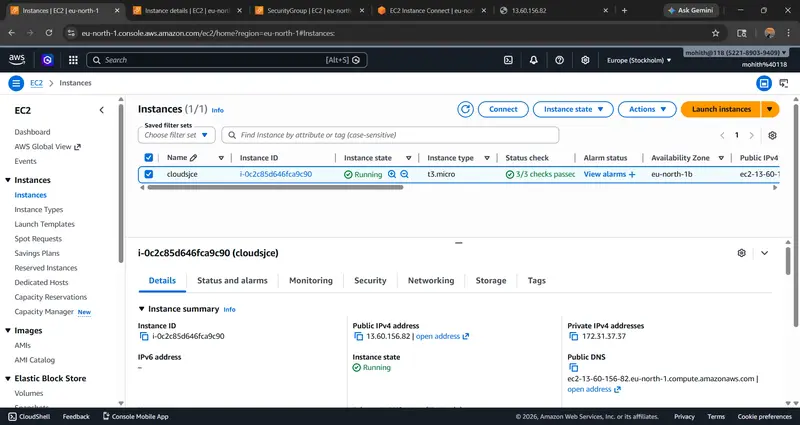
Launch a Simple EC2 Instance, Run a Web Server & Access It from the Internet – CA28

one of the first things you should try is launching an EC2 instance and hosting a simple website. In this guide, we’ll create an EC2 instance, install a web server, and access it from the public internet.

Step 1 — Launch EC2 Instance

  1. Go to AWS Console
  2. Open EC2 Dashboard
  3. Click Launch Instance

Configure:

Name

My-Web-Server

AMI

Amazon Linux 2023

Instance type

t2.micro (Free tier)

Step 2 — Configure Security Group

Allow SSH and HTTP traffic:
type – ssh & http is in port 22 & 88 sorce is my ip and anywhere

This allows:

  • SSH login
  • Public web access

Step 3 — Connect to EC2

Use EC2 Instance Connect web browser on console :

throught the above connect option present in it

Step 4 — Install Apache Web Server

Update packages

sudo yum update -y

Install Apache

sudo yum install httpd -y

Start server

sudo systemctl start httpd

Enable auto start

sudo systemctl enable httpd

Step 5 — Create Simple Website

Create index file:

sudo nano /var/www/html/index.html

Enter the html code

<!DOCTYPE html>
<html>
<head>
    <title>My EC2 Website</title>
</head>
<body>
    <h1>Hello from EC2 </h1>
    <p>My HTML is working!</p>
</body>
</html>

Save and exit.

Step 6 — Access Website from Internet

Copy Public IPv4 address
Open in browser:

http://your-public-ip

Example:

http://13.60.156.82

You should see:

Hello from EC2 
My first AWS hosted website

Architecture

Browser → Internet → EC2 Public IP → Apache → HTML Page

Common Issue (IMPORTANT)

If website not loading:
Check Security Group:
Wrong:

HTTP 80 → 0.0.0.0/32 

Correct:

HTTP 80 → 0.0.0.0/0 

This allows internet access.

Useful Commands

Check server status

sudo systemctl status httpd

Restart server

sudo systemctl restart httpd

Stop server

sudo systemctl stop httpd

What i Learned from this is

✅ Launch EC2 instance
✅ Configure security group
✅ Install Apache web server
✅ Deploy HTML page
✅ Access from internet

ISO 27001 Just Got the Same Treatment as SOC2

March 29, 2026

Three months ago, I introduced “The Deterministic SOC2 API.” The response was silence, then traffic, then Google ranking, then the AI Overview citing my articles as the definitive source on deterministic decision logs.

But one question kept surfacing in the way people searched.

They searched for “ISO 27001 decision logs.” They searched for “multi‑framework audit trails.” They searched for “how to prove AI decisions comply with both SOC2 and ISO.”

They had the same problem in a different framework.

Today, that gap closes.

The Multi‑Framework Reality

Companies running parallel compliance programs know the pain. You have SOC2 for your US customers. You have ISO 27001 for your European contracts. You have overlapping controls, separate audits, duplicate evidence.

The same access control decision that satisfies SOC2 CC6.1 also satisfies ISO 27001 A.9.2.1. The same change management decision that satisfies SOC2 CC7.1 also satisfies ISO 27001 A.12.1.2.

But until now, no single system captured both.

One API call. One decision. Two framework citations.

What a Multi‑Framework Decision Looks Like

Here’s a real example from our API, updated today:

Input (a privileged access request):

{
“scenario_summary”: “Emergency production access”,
“observed_signals”: [“admin added to IAM role”, “no change ticket found”],
“known_context”: [“incident response active”, “on‑call engineer approved”]
}

Output (simplified):

{
“decision_posture”: “proceed”,
“confidence”: 75,
“compliance_references”: [
“SOC2 CC6.1 — Logical Access Security”,
“SOC2 CC7.2 — System Monitoring”,
“ISO27001 A.9.2.1 — User Access Provisioning”,
“ISO27001 A.12.4.1 — Event Logging”
],
“decision_rationale”: “Emergency access requested during active incident. On‑call approval present. SOC2 CC6.1 requires access controls; exception granted due to incident. ISO 27001 A.9.2.1 requires documented access provisioning; emergency deviation logged. Monitoring will capture any anomalous activity post‑access.”,
“clarifying_question”: null
}

This is not evidence collection. This is decision‑level audit across multiple frameworks.

  • One decision
  • Two frameworks
  • Four control citations
  • Full rationale
  • Deterministic, replayable, verifiable

Why This Matters for ISO 27001

ISO 27001 requires an Information Security Management System (ISMS) that is risk‑based, documented, and continuously improved. The standard’s Annex A controls (A.5 through A.18) cover everything from access control to incident management.

What ISO 27001 auditors actually look for:

| Control | What They Want | Your API Provides |
| A.9.2.1 (User access provisioning) | Proof that access decisions followed policy | Deterministic logs with access signal mapping |
| A.12.1.2 (Change management) | Evidence that changes were reviewed and approved | Decision rationale with change signal detection |
| A.12.4.1 (Event logging) | Tamper‑proof record of security events | Deterministic, replayable decision logs |
| A.8.1.1 (Asset inventory) | Visibility into what systems are being protected | Asset‑related signals mapped to control |
| A.5.1.1 (Information security policies) | Proof that controls align with documented policies | Decision rationale cites policy where applicable |

No compliance platform captures these at the decision level. No one.

Write on Medium
The Overlap That Saves Months

The same input signals that map to SOC2 CC6.1 map directly to ISO 27001 A.9.2.1. The same change management signals map to SOC2 CC7.1 and ISO 27001 A.12.1.2.

This is not a coincidence. The frameworks were designed to be complementary. But the tools that implement them treat them as separate.

One API. One decision. Two frameworks. No duplication.

What This Means for Compliance Teams

If you’re running SOC2 and ISO 27001 in parallel:

  • You no longer need separate evidence collection
  • You no longer need separate audit trails
  • You no longer need to explain to auditors why the same decision appears in two different systems

Your auditors see one record: the decision, the rationale, the control mapping for both frameworks, all in one place.

What This Means for Engineering Teams

If you’re building systems that need to comply with both frameworks:

  • You call one API
  • You get back compliance references for both frameworks
  • You store one log entry
  • You satisfy two audit requirements

That’s not efficiency. That’s leverage.

What This Means for the Market

The shift from single‑framework to multi‑framework compliance is accelerating. Companies don’t just need SOC2. They need SOC2 + ISO 27001 + HIPAA + FedRAMP.

The platforms that treat each framework as a separate module are falling behind.

We treat frameworks as mappings. One API. Infinite frameworks. One price.

What’s Next

The API now returns both SOC2 and ISO 27001 references. HIPAA, FedRAMP, and cyber insurance controls are in development.

The lattice is growing.

If you’re running parallel compliance programs and wondering why your decision logs don’t cover both frameworks — now you know.

It’s not that it’s hard. It’s that no one built it. Until now.

Founder & CEO, Decision Security Layer
[email protected]
API Docs

ISO27001 #SOC2 #compliance #multi‑framework #deterministic #API

🚀 How I Upgraded My AI Workflow Using MCP (And Stopped AI Guessing)

I spent some time recently improving how I use AI in my editor—and honestly, this changed everything.

👉 I stopped treating AI like a chatbot… and started using it like a real development tool ⚙️

🧠 The Shift

I set up Model Context Protocol (MCP) in Cursor.

Before this, AI responses were fast—but sometimes wrong.
Now, instead of guessing based on training data, the assistant works with real context.

⚙️ What MCP Actually Does

With MCP, the AI can:

  • 📄 Pull real documentation
  • 🧩 Check GraphQL schemas
  • ✅ Validate APIs
  • 🗄️ Safely reference database context

In simple terms:
💡 Less hallucination. More accuracy. Real answers.

🔌 What I Integrated

Here’s my current setup:

  • Shopify MCP → Accurate API + GraphQL support 🛍️
  • Context7 → Version-aware library documentation 📚
  • MongoDB MCP → Read-only database context 🧠

This makes the assistant behave much closer to how things actually work in production.

🚀 Why This Matters

After using this setup, here’s what improved:

  • ❌ Fewer wrong endpoints or fields
  • 🔍 Less time jumping between docs
  • ⚡ Faster and more confident development

Especially if you’re working across stacks (like Shopify + backend), this makes a big difference.

🛠️ Final Thought

MCP isn’t magic ✨
It’s just good plumbing.

And good plumbing saves hours of debugging.

🤔 Your Turn

If you’re still using AI only in chat mode, you’re probably missing out.

Have you tried MCP or something similar?
Would love to hear your experience 👇

🏷️ Tags

#mcp #ai #developertools #softwaredevelopment #cursor