
ARC-AGI-3, launched just yesterday on March 25, 2026, represents the most radical transformation of the ARC benchmark since François Chollet introduced it in 2019 — abandoning static grid puzzles entirely in favor of interactive, video-game-like environments where AI agents must discover rules, set goals, and solve problems with zero instructions.
The competition carries over $2 million in prizes across three tracks. Early preview results: frontier LLMs like GPT-5 and Claude score below 1%, while simple CNN and graph-search approaches reach 12.58%. The gap between human performance (100%) and the best AI agent remains enormous.
From grid puzzles to game worlds: what changed

ARC-AGI-3 is not an incremental difficulty upgrade — it is a fundamentally different benchmark. Previous versions (ARC-AGI-1 and ARC-AGI-2) presented static input-output grid pairs where systems inferred transformation rules and applied them. ARC-AGI-3 instead drops agents into turn-based game environments with no stated rules, no instructions, and no win conditions. Agents observe a 64×64 grid with 16 colors, take actions (move, click, reset), and must figure out both what to do and how to do it through pure interaction.
The benchmark comprises 1,000+ levels across 150+ handcrafted environments, each game containing 8–10 levels that progressively introduce new mechanics. Three preview games illustrate the range: ls20 requires navigating a map and transforming symbols, ft09 involves matching patterns across overlapping grids, and vc33 tasks agents with adjusting volumes to hit target heights. Scoring uses action efficiency — how many actions the agent needs compared to a human baseline — rather than binary pass/fail. A perfect 100% means the AI matches human efficiency across all games.
The evolution across versions tells a clear story of escalating challenge:
| Feature |
ARC-AGI-1 (2019) |
ARC-AGI-2 (2025) |
ARC-AGI-3 (2026) |
| Format |
Static grid puzzles |
Static grid puzzles (harder) |
Interactive game environments |
| Instructions |
Input-output demo pairs |
Input-output demo pairs |
None — discover through interaction |
| Best AI score |
~90%+ (saturated) |
24% (competition) |
12.58% (preview) |
| Human baseline |
~85% |
~60% average |
100% |
| Scoring |
Binary accuracy |
Accuracy + cost-per-task |
Action efficiency vs. humans |
| Tasks |
~400 training + 100 eval |
1,000 training + 120 eval per split |
1,000+ levels, 150+ environments |
ARC-AGI-1 became effectively saturated by 2025, with frontier models hitting 90%+ through brute-force engineering. ARC-AGI-2 introduced harder compositional tasks — symbolic interpretation, contextual rule application, multiple interacting rules — that dropped the best competition score to 24%. ARC-AGI-3 tests four entirely new capabilities: exploration (actively gathering information), modeling (building generalizable world models), goal-setting (identifying objectives without instructions), and planning with execution (strategic action with course-correction).
Preview leaderboard reveals LLMs’ interactive reasoning gap
The competition literally launched yesterday, so the official Kaggle leaderboard has no entries yet. However, a 30-day developer preview preceding the launch produced highly informative results from 12 submissions (8 tested on private games):
| Rank |
Team |
Approach |
Score |
Levels Solved |
| 1st |
StochasticGoose (Tufa Labs) |
CNN + RL action-learning |
12.58% |
18 |
| 2nd |
Blind Squirrel |
State graph exploration + ResNet18 |
6.71% |
13 |
| 3rd |
Explore It Till You Solve It |
Training-free frame graph |
3.64% |
12 |
| — |
Best frontier LLM agent |
LLM-based |
<1% |
~2–3 |
| — |
Human players |
Human cognition |
100% |
All |
All three top systems used non-LLM approaches. StochasticGoose, built by Dries Smit at Tufa Labs, employed a CNN-based action prediction model with simple reinforcement learning and sparse rewards (only level completion signals). It stored frame transitions in memory for off-policy training, used hash tables to avoid duplicate states, and iteratively retrained its model between levels. The team explicitly avoided LLMs because the observation complexity — hundreds of interaction steps — would generate millions of tokens.
The third-place system, documented in an arXiv paper (Rudakov et al., 2512.24156), used a completely training-free graph-based exploration method, building state graphs and systematically exploring them. It solved a median of 30 out of 52 levels across 6 games but was limited by computational scaling with state space size.
Frontier LLMs’ sub-1% performance is perhaps the most significant data point. The interactive format — requiring sustained sequential reasoning, state tracking across hundreds of steps, and learning from environmental feedback — exposes a fundamental limitation of current language models that static benchmarks never tested.
$2 million across three tracks with strict open-source requirements
The ARC Prize 2026 splits its prize pool across three parallel competition tracks, each hosted on Kaggle:
ARC-AGI-3 Track — $850,000 total:
The grand prize of $700,000 goes to the first agent scoring 100% on evaluation (carries over if unclaimed). A guaranteed $75,000 top-score award distributes $40K/1st, $15K/2nd, $10K/3rd, and $5K each for 4th–5th. Two milestone prizes totaling $75,000 reward early progress: $25K/$10K/$2.5K at each milestone (June 30 and September 30).
ARC-AGI-2 Track — ~$1 million: The $700K grand prize for scoring 85% on ARC-AGI-2 remains unclaimed from both 2024 and 2025, and continues into 2026 alongside separate score awards.
Paper Prize Track: Awards for research papers advancing understanding of strong ARC-AGI performance.
Critical competition constraints shape viable approaches. All winning solutions must be open-sourced under permissive licenses (CC0 or MIT-0) before receiving private evaluation scores. Kaggle evaluation runs with no internet access — meaning no API calls to OpenAI, Anthropic, Google, or any cloud inference endpoint. Teams must either use open-weight models running locally or build entirely non-LLM systems. The ARC-AGI-3 toolkit is open-source (MIT license, pip install arc-agi) and runs at 2,000+ FPS locally, but requires an API key from arcprize.org.
What approaches are competitors likely to pursue
The preview results and historical ARC competition patterns suggest several viable research directions for ARC-AGI-3:
Reinforcement learning with lightweight neural networks is the proven frontrunner. StochasticGoose’s CNN + sparse RL approach dominated the preview. Simple action prediction models that learn which actions cause meaningful state changes, combined with systematic exploration, appear far more effective than sophisticated language understanding.
Graph-based state exploration offers a training-free alternative. Building explicit state graphs, pruning loops, and systematically mapping environment dynamics worked surprisingly well (6.71% for Blind Squirrel). This approach trades compute for algorithmic efficiency but scales poorly with state space size.
Meta-learning and curiosity-driven RL are natural fits given ARC-AGI-3’s requirement for rapid adaptation to novel environments. Methods like BYOL-Hindsight and intrinsic motivation were discussed during the preview period but proved finicky with short timeframes and sparse rewards.
World models (Dreamer family, latent dynamics models) could learn environment physics in imagination before acting, but are limited by ARC-AGI-3’s sparse reward signal — only level completion provides feedback.
For the continuing ARC-AGI-2 track, the dominant paradigm from 2025 was synthetic data generation combined with test-time training — NVARC’s winning approach used Qwen3-4B fine-tuned on 103K synthetic puzzles plus 3.2M augmented samples. Other strong directions include masked diffusion models (ARChitects), evolutionary program synthesis (SOAR), and minimum description length approaches (CompressARC).
Key dates and competition timeline
| Date |
Milestone |
| March 25, 2026 |
Competition opens on Kaggle |
| June 30, 2026 |
ARC-AGI-3 Milestone #1 ($37,500 in prizes) |
| September 30, 2026 |
ARC-AGI-3 Milestone #2 ($37,500 in prizes) |
| November 2, 2026 |
All submissions due |
| November 8, 2026 |
Paper track submissions due |
| December 4, 2026 |
Results announced |
During the competition, Kaggle leaderboard standings reflect scores on a semi-private dataset. Final rankings and prize eligibility use a separate private dataset, following the same anti-gaming structure as previous years. Human calibration data was collected from 1,200+ players across 3,900+ games during the preview, with a controlled study of 200+ participants establishing production baselines.
Try it yourself
ARC-AGI-3 toolkit is open-source and runs locally:
pip install arc-agi
You’ll need an API key from arcprize.org to access the environments. The toolkit runs at 2,000+ FPS locally.
Full competition details and submission: ARC Prize 2026 on Kaggle
Conclusion
ARC-AGI-3 is not merely a harder test — it measures a fundamentally different kind of intelligence. The shift from static pattern recognition to interactive exploration and goal discovery exposes capabilities that current AI systems, including frontier LLMs, demonstrably lack. The preview data is unambiguous: simple RL and graph search at 12.58% versus frontier LLMs below 1% suggests that the path to solving ARC-AGI-3 runs through novel algorithmic ideas rather than model scaling.
With $850K on the line for the interactive track alone and milestone prizes creating incentives for early progress, the next eight months should produce significant advances in adaptive AI reasoning — all of which, by competition rules, will be open-sourced for the broader research community.
Are you planning to compete? What approach would you try? Drop your thoughts in the comments.
We’re CodePawl — an open-source-first firm building tools for developers. Follow us on X or join our Discord.

 Google’ın resmi olarak “TurboQuant” adını verdiği yeni yapay zeka odaklı sıkıştırma algoritması, büyük dil modellerinin (LLM) bellek kullanımını 6 kat azaltabiliyor. Ses getiren çalışması için yaptığı açıklamada, “Yeni sıkıştırma algoritmamız yapay zeka verimliliğini yeniden tanımlıyor. Büyük dil modellerinin (LLM) anahtar-değer (KV) önbellek bellek kullanımını en az 6 kat azaltan bu teknoloji, doğruluktan ödün vermeden 8 kata kadar hız artışı sağlıyor.” ifadelerini kullanan şirket, algoritmanın yapay zeka işlemlerindeki önbellek darboğazlarını gidermek adına vektör kuantizasyonu kullandığını belirtiyor. Bu yöntem yapay zekanın daha az alan kaplayarak ve doğruluğu koruyarak daha fazla bilgi hatırlamasına olanak tanıyor. Yeni algoritma, birçok kişinin aklına doğrudan HBO’nun çok sevilen “Silicon Valley” dizisini ve dizinin merkezinde yer alan girişim Pied Piper’ı getirdi. Pied Piper’ın televizyon dizisindeki çığır açan teknolojisi, neredeyse kayıpsız sıkıştırma ile dosya boyutlarını önemli ölçüde azaltan bir sıkıştırma algoritmasıydı. So Google TurboQuant is basically Pied Piper and just hit a Weismann Score of 5.2 https://t.co/WievkwijjD pic.twitter.com/4rirvu2YyV — […]
 En son bir isim değişikliğiyle gündeme gelen (daha önce Samsung Internet Browser olarak geçiyordu) Samsung Browser tarayıcının Windows sürümü bugün itibarıyla betadan çıkarıldı. Uzun yıllardır Galaxy cihazlarda yer alan tarayıcı, Windows’a spesifik olarak 30 Ekim’de taşınmıştı. Windows 10 (1809 ve üzeri) ile Windows 11 PC’lerde kullanılabilen ve ARM işlemcili PC’lere de destek veren tarayıcı, açılan sayfaların özetlerini çıkarabilen ve çeviri yapabilen faydalı yapay zeka özellikleri barındırıyor. PC ile telefonlar arasında sekme senkronizasyonu yapabilen sürüm, Samsung Pass desteğine de sahip ve bulut tabanlı yedekleme yapabiliyor. Küresel olarak çıkan tarayıcı buradan ücretsiz olarak indirilebiliyor.
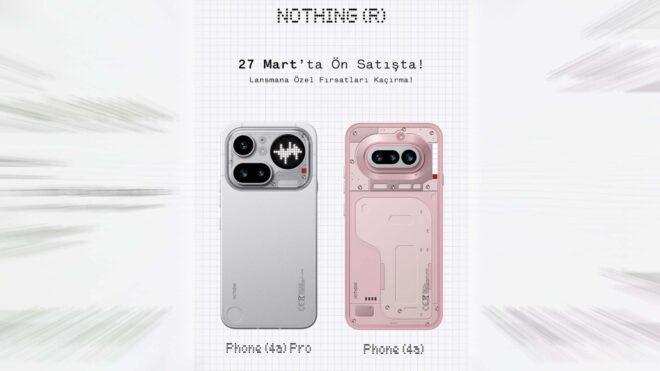
 Yapılan resmi doğrulamaya göre kısa süre önce tanıtılan Nothing Phone (4a) ve Phone (4a) Pro modelleri 27 Mart’ta Türkiye’de satışa sunulacak. Arka tasarımlarıyla dikkat çeken telefonlardan Phone (4a) Pro, metal çerçeve üzerine kuruluyor ve IP65 sertifikasıyla geliyor. Phone (4a) modelinin arkasına 63 mini LED’den oluşan 7 parçalı bir “Glyph Bar” konumlandıran Nothing, Phone (4a) Pro’da ise Glyph Matrix isimli, 137 farklı mini LED’den oluşan nokta/piksel bazlı yuvarlak bir ekrana yer veriyor. Phone (4a), teknik olarak baktığımız zaman 6,78 inç “30–120 Hz” AMOLED ekranla donatılmış ve 32 megapiksellik selfie kamerası taşıyor. Gücünü Snapdragon 7 Gen 4 işlemciden alan telefonda 50W şarj destekli 5.400 mAh’lık batarya kullanılıyor. Telefonun arkasında ise 50 megapiksel geniş açı (Samsung GN9), 50 megapiksel 3,5x periskop telefoto (Samsung JN5 / 70x’e kadar dijital/hibrit zoom) ve 8 megapiksel ultra geniş açı (Sony IMX355) kameralar bir araya getiriliyor. Phone (4a) Pro ise 6,83 inç “30–144 Hz” AMOLED ekranla donatılmış ve […]

 Facebook, Instagram, WhatsApp ve fazlasının çatı şirketi Meta, aktarıldığı kadarıyla 1.000’e yakın çalışanını işten çıkarıyor. Reality Labs başta olmak üzere beş farklı departmana yayıldığı aktarılan yeni işten çıkarma süreci, yalnızca ABD’deki çalışanları da kapsamıyor. 31 Aralık itibarıyla 79 binden fazla çalışana sahip olduğu belirtilen şirket, geçtiğimiz hafta yakında 15 binden fazla kişiyle yollarını ayırabilir haberleriyle gündeme gelmişti. 2022’nin sonunda tam 22 bin kişiyi etkileyen devasa bir işten çıkarma sürecine başlayan şirket, son dönemde tüm odağını yapay zeka tarafına çevirmiş durumda.


