Vites topuzuna akıllı saat entegre eden sürücü gündem oldu
Yazılım bilgisi olmayan bir kullanıcı araç içerisinde vites hareketlerini anlık olarak algılayacak ve müzik oynatıcısını kontrol edecek akıllı bir vites topuzu geliştirmeyi başardı.
Ugreen, Çin’de ekranlı yeni 45W USB-C GaN hızlı şarj adaptörünü tanıttı. Tasarımıyla dikkatleri çeken şarj aletinin ön bölümde yer alan küçük ekran sayesinde anlık şarj bilgileri görüntülenebiliyor.I took a screenshot of code with a SQL injection vulnerability, compressed it twice through WhatsApp, and fed it to Gemma 4 running entirely on my 8GB RAM laptop.
One minute and forty-seven seconds later, it pointed out the exact dangerous line, explained why it was vulnerable, and showed the correct way to fix it.
I’m a 19-year-old self-taught developer in Nigeria. I don’t have a high-end machine or a GPU. Just a consumer laptop, an internet connection, and four years of figuring things out alone.
When Google released Gemma 4, I skipped most of the benchmark discussions and tested it myself to see what it could actually do on limited hardware.
This is that report.
TL;DR for the skimmers:
What Gemma 4 Actually Is:
Before I get into what I found, here’s the context you need.
Gemma 4 is Google DeepMind’s latest family of open models. Open means you can download the weights and run them locally — no API costs, no data leaving your machine. For reference: E2B downloads at 7.2GB best for 8gb RAM device, E4B at 9.6GB best for 16gb RAM.
The family comes in three variants:
E2B and E4B — The Edge Models
Built for ultra-low resource deployment. Think mobile devices, Raspberry Pi, laptops without GPUs. E2B has around 2 billion effective parameters. E4B has around 4 billion. These are the models that run on hardware most developers in the world actually own. This is what I tested.
31B Dense — The Bridge Model
31 billion parameters in a dense architecture. Sits between consumer hardware and full server deployment. Bridges the gap between what you can run locally on a powerful machine and what requires a data center.
26B MoE — The Efficient Reasoner
26 billion parameters in a Mixture-of-Experts architecture. Not all parameters activate for every token; only the relevant experts fire. This makes it highly efficient for reasoning tasks at scale without burning through compute proportionally.
I tested E2B. Here’s why that matters for developers like me.
Test 1 — Vision: Low quality Image Test
This was not a clean lab test. This was real world conditions.
I had a screenshot of an Express.js route with a SQL injection vulnerability — the classic mistake where user input goes directly into a database query without sanitization. Instead of taking a clean screenshot and uploading it properly, I sent it through WhatsApp. Then I downloaded it and sent it through WhatsApp again. Anyone who has done this knows what happens; WhatsApp compresses images aggressively. By the time I fed it to Gemma 4, the image quality had degraded significantly.
I opened Google AI Studio, loaded Gemma 4, uploaded the image, and asked it to review the code for security issues.
What happened:
One minute and forty-seven seconds later; on a fresh boot with nothing else running Gemma 4 returned a structured response that:
The output was specific. It referenced the actual code in the image, not generic advice. It did not say “make sure you validate your inputs.” It said here is the line, here is why it is dangerous, here is the fix.
Why this matters:
Most developers do not have perfect screenshots. They have photos of monitors taken in bad lighting, screenshots forwarded through three different messaging apps, images captured on a low-end phone. The documentation never tests for this. I did.
Gemma 4 processed a degraded, double-compressed image and returned accurate, actionable output. For a model running on consumer hardware, that is not nothing. That is the difference between a model that works in a lab and a model that works in the real world.
Test 2 — The Finding Nobody Else Will Write About
I asked Gemma 4 to explain JWT authentication JSON Web Tokens, a common auth mechanism in three Nigerian languages: Yoruba, Hausa, and Igbo.
This took approximately two minutes and fifty seconds. By this point I had more files open and my RAM was no longer as fresh as the first test. The model was noticeably slower.
But here is what it returned.
Hausa:
The response was accurate and natural. The model understood the request, switched languages correctly, and explained the concept in a way that read like genuine Hausa rather than a mechanical translation. For a locally running model with no internet access during inference, this was genuinely surprising.
Yoruba:
The response came through but with drift. Yoruba has tonal markers — accent marks that change the meaning of words entirely. Without those diacritics in my prompt, the output was approximate rather than precise. Writers targeting Yoruba-speaking audiences would need to verify carefully before publishing anything.
Igbo:
Similar story. Igbo has its own special characters and tonal markers. The model approximated and the nearest recognizable output came through; but it was not fully accurate Igbo. Close enough to understand, not close enough to trust without review.
What this means practically:
There are over 500 million people in West Africa. There are writers, developers right now building and writing for users who speak Hausa, Yoruba, Igbo, Twi, Amharic, Swahili. Those writers need to know exactly what these models can and cannot do in local languages before they ship something.
Here is my honest assessment:
Gemma 4 E2B handles Hausa better than I expected. Yoruba and Igbo have limitations tied directly to diacritics if your prompt does not include them, the output won’t either. For a model running entirely offline, the multilingual capability is remarkable. For production use in tonal African languages, test before you ship.
Test 3 — The 128K Context Window on 8GB RAM
The spec sheet says Gemma 4 supports a 128K context window. That number means nothing without knowing what it costs to use it on consumer hardware.
I fed it an entire README file — a long, detailed project documentation file — and asked for a structured summary.
It took five minutes to complete.
The output was accurate. It understood the document. It structured the summary well. It did not hallucinate content that was not there. It captured the main purpose, the architecture, the setup steps, and the key features correctly.
Five minutes is slow by cloud standards. By the standard of a free, private, offline model running on 8GB RAM with no GPU, five minutes to accurately process and summarize a long document is a different conversation entirely.
The 128K context window is not just a spec sheet number. It held an entire document in memory and reasoned about it correctly. For developers building tools that need to process long files — entire codebases, full documentation, lengthy configuration files — E2B can do this on hardware you already own. Just plan for the time it takes.
The RAM Reality Nobody Documents
Here is practical information that is not in the official documentation anywhere.
I noticed a clear performance pattern across my tests:
| Test | RAM State | Time to Complete |
|---|---|---|
| Vision + code review | Fresh boot, nothing open | 1 min 47 sec |
| Multilingual explanation | Multiple files open | 2 min 50 sec |
| Long context summary | Heavy use, many tabs | ~5 minutes |
The pattern is obvious once you see it. As RAM fills with other processes, Gemma 4 E2B slows down significantly. This is not a flaw. The model needs memory to run and it competes with everything else on your machine.
Practical advice for 8GB RAM users:
I learned all while trying to build with it
Which Model Should You Actually Use
Stop reading benchmarks and use this decision guide instead.
You have an 8GB RAM laptop with no GPU → Gemma 4 E2B via Ollama. Nothing else is realistic.
Your project handles sensitive data and privacy is critical → Any Gemma 4 variant running locally via Ollama. Your data stays on your machine. Full stop.
You are building for multilingual users in Africa or South Asia → E2B has meaningful multilingual capability. Test your specific languages before shipping. Hausa works well. Tonal languages with special characters need careful prompting.
You need high performance for a server deployment → 31B Dense is your target.
You need efficient reasoning at high throughput → 26B MoE is built for this.
You are building for mobile or edge devices → E2B or E4B. These models were designed for exactly this hardware profile.
Your budget is zero and you need full capability → E2B via Ollama. Free to download, free to run, free forever. No API key. No subscription. No data leaving your machine.
What Running AI Locally Actually Means
Every conversation about AI accessibility focuses on API costs and internet connectivity. Those are real barriers. But there is a third barrier that nobody talks about: trust.
When a developer in Lagos pastes their production code into ChatGPT or any cloud AI tool, that code leaves their machine. If there are API keys in that code, database connection strings, auth secrets — they just went to a server somewhere. Most developers do not think about this. Most beginners definitely do not.
Running Gemma 4 locally via Ollama removes that problem entirely. Your code goes from your editor to your RAM and back to your screen. Nothing else happens. No network request. No logging. No third party.
For a self-taught developer building their first real project, that matters. For a developer in a region where cloud AI costs are prohibitive relative to local income, that matters. For anyone building tools that touch sensitive user data, that matters.
Gemma 4 E2B is not the most powerful model available. It is not trying to be. What it is — a capable, multimodal, multilingual model that runs on hardware most developers in the world actually own, for free, privately, offline — is something different from anything that existed before it.
There is a difference between a model that exists and a model that runs on hardware people actually own.
That difference is the whole thing.
How To Get Started Right Now
If you have not pulled Gemma 4 yet, here is everything you need.
Step 1 — Install Ollama
Go to ollama.com and download it for your operating system. Install it like any normal application.
Step 2 — Pull Gemma 4 E2B
ollama pull gemma4:e2b
This downloads the model to your machine. Approximately 2-3GB. You only do this once.
Step 3 — Start Ollama
ollama serve
This runs Ollama in the background on localhost port 11434. Leave this terminal open.
Step 4 — Test it immediately
ollama run gemma4:e2b "explain what a SQL injection attack is to a complete beginner"
If you get a response, everything is working. You are now running a capable multimodal AI model locally on your own machine at zero cost.
Step 5 — Try the vision capability
Head to aistudio.google.com, select Gemma 4, upload a screenshot of any code, and ask it to review for security issues. No setup required. See what it catches.
Final Thought
I started these tests expecting to be disappointed. Consumer hardware running open models has usually meant compromises — slow inference, shallow responses, limited context.
What I found instead was a model that analyzed a WhatsApp-compressed screenshot and caught a real security vulnerability. That explained JWT authentication in Hausa. That summarized long documents on 8GB RAM. All privately, offline, and free.
The compromises are still real. The speed is nowhere near cloud models. The tonal language limitations matter. The RAM constraints are physics.
But benchmark scores are measured in controlled environments on optimized hardware by people who are not your users.
I am the user.
8GB RAM. Nigeria. WhatsApp screenshots. Nigerian languages. Midnight deadlines.
And if Gemma 4 works in those conditions, then it works in the real world.
That is the benchmark that matters to me..
Pull it. Test it. Build with it.
ollama pull gemma4:e2b
Everything else is waiting on the other side of that command.
Tested on: 8GB RAM laptop, Windows, Ollama + Google AI Studio, May 2026
Models tested: Gemma 4 E2B
Location: Nigeria

Before we begin — if you’re interested in improving engineering quality and developer workflows, check out git-lrc on GitHub — a free micro AI code review tool that runs on every commit. If the idea resonates with you, consider giving the project a ⭐ on GitHub.
Python developers are used to expressive code.
You can automate workflows in minutes, prototype products quickly, manipulate huge datasets, and build entire backends with surprisingly little code.
But eventually many developers run into a frustrating problem:
“How do I know my program is actually correct?”
You can write tests.
You can add type hints.
You can run linters.
But tests only sample behavior.
They do not prove correctness.
That’s where Lean becomes fascinating.
Lean 4 is not just a programming language.
It’s also:
If you’re coming from Python, Lean can feel strange at first.
But once the mental model starts clicking, it genuinely changes how you think about programming.
This article is a beginner-friendly introduction to Lean 4 specifically for Python programmers.
The Biggest Difference: Lean Wants Precision
Python is flexible by design.
For example:
def add(a, b):
return a + b
Python is happy with this.
But think carefully:
a and b?Python delays those decisions until runtime.
Lean does the opposite.
In Lean:
def add (a : Nat) (b : Nat) : Nat :=
a + b
This explicitly says:
a is a natural numberb is a natural numberAt first this can feel verbose to Python developers.
But Lean’s philosophy is interesting:
Ambiguity is usually hidden complexity.
Lean tries to eliminate hidden assumptions.
Your First Lean Functions
Let’s compare Python and Lean side by side.
Python:
def square(x):
return x * x
Lean:
def square (x : Int) : Int :=
x * x
Very similar.
Now let’s try something slightly more interesting.
Python factorial:
def factorial(n):
if n == 0:
return 1
return n * factorial(n - 1)
Lean factorial:
def factorial : Nat → Nat
| 0 => 1
| n + 1 => (n + 1) * factorial n
This looks unusual initially.
What’s happening here?
Lean uses pattern matching.
Explanation:
0, return 1
n + 1
This style is extremely common in functional programming.
And importantly:
Lean can reason formally about recursive definitions.
Lean Cares Deeply About Correctness
Here’s a subtle Python issue:
def divide(a, b):
return a / b
Looks harmless.
But:
divide(10, 0)
Runtime error.
Python lets dangerous states exist until execution.
Lean pushes you to think earlier.
For example, Lean separates different numeric systems carefully:
That strictness is not accidental.
Lean assumes:
if something matters logically, it should be represented explicitly.
This is one reason theorem provers are powerful.
Immutable Thinking Feels Different
Python programmers often mutate state:
count = 0
def increment():
global count
count += 1
Lean strongly prefers immutable transformations:
def increment (n : Nat) : Nat :=
n + 1
Instead of changing existing state:
Why is this important?
Because mutable state becomes difficult to reason about formally.
Imagine trying to mathematically prove correctness of a large system where:
Functional programming reduces this chaos.
That’s one reason languages like Lean heavily embrace immutability.
Types in Lean Are Much More Powerful Than Python Type Hints
Python type hints help developers.
Lean types help prove things.
That’s a huge distinction.
Python:
def greet(name: str) -> str:
return "Hello " + name
Helpful, but not enforced rigorously.
Lean types can encode logical guarantees.
For example, you can express:
That’s where Lean starts feeling less like programming and more like formal reasoning.
A tiny theorem:
theorem add_zero (n : Nat) : n + 0 = n := by
rfl
This proves:
adding zero changes nothing
Breaking it down:
theorem declares a proposition(n : Nat) means for any natural number n
: n + 0 = n is the claimby starts proof moderfl means “this is true by direct simplification”This may look trivial.
But Lean scales this exact mechanism to verify extremely sophisticated systems.
Lean Proofs Feel Like Interactive Debugging
One surprising thing about Lean:
Writing proofs often feels similar to debugging.
Suppose we define list length.
def length : List α → Nat
| [] => 0
| _ :: xs => 1 + length xs
Explanation:
otherwise:
_)Now imagine proving something about lists.
Lean gives continuous feedback:
This creates a very interactive workflow.
Python developers often enjoy REPL-driven development.
Lean has a similar “conversation with the system” feeling.
Except instead of debugging runtime behavior, you debug logical reasoning.
Tactics: Step-by-Step Proof Construction
Lean proofs are often built using tactics.
Example:
theorem reverse_reverse (xs : List Nat) :
xs.reverse.reverse = xs := by
simp
What does this mean?
It proves:
reversing a list twice returns the original list
And simp tells Lean:
simplify using known rules
Some useful beginner tactics:
simp → simplify expressionsrw → rewrite using known equalitiesintro → introduce assumptionsexact → directly provide proofapply → use another theoremThink of tactics like:
Over time they become surprisingly intuitive.
Lean Quietly Improves Your Software Engineering
Even if you never become a theorem proving expert, Lean changes how you think.
You start asking:
This mindset transfers back into ordinary engineering.
You often begin writing:
Ironically, learning Lean can improve your Python.
How Python Developers Should Learn Lean
A good beginner path:
1. Learn basic functional programming ideas
Focus on:
2. Install Lean + VS Code
Using Visual Studio Code with the Lean extension gives excellent feedback.
3. Ignore advanced math initially
Many beginners get overwhelmed because online discussions quickly become abstract.
Start simple:
4. Build tiny programs
Good practice ideas:
5. Expect gradual progress
Lean is closer to learning chess or mathematics than learning a typical framework.
The intuition develops slowly.
Conclusion
Lean 4 represents a very different philosophy of programming.
Python asks:
“Can we make development faster and more flexible?”
Lean asks:
“Can we make reasoning precise and verifiable?”
Both philosophies matter.
But as software systems become increasingly complex — especially in:
— the ability to formally reason about correctness may become far more important.
And perhaps that’s the most interesting thing about Lean:
It doesn’t just teach syntax.
It teaches disciplined thinking.
So here’s a question to leave you with:
If AI increasingly generates code automatically, do developers become more valuable not for writing code — but for verifying whether systems are actually correct?
That future may arrive sooner than we think.
And if it does, theorem provers like Lean may eventually move from research circles into mainstream software engineering.
And again — if you’re interested in developer tooling around engineering quality, check out git-lrc on GitHub — a free micro AI code review tool that runs on commits — and consider giving the project a ⭐ if you’d like to support it.
This is a submission for the Google I/O Writing Challenge
From Assistants to Agents: My Take on Google I/O 2026
Google I/O 2026 was the moment Google fully embraced agentic AI. Rather than showing incremental improvements, this year’s announcements reframed Gemini as an ecosystem of models, tools and platforms designed to act on our behalf.
In this post I’ll unpack the key releases, highlight some exceptional projects from Google’s Gemini Live Agent Challenge, and share my perspective on what these advances mean for developers.
The Evolution of Gemini: Omni, Flash 3.5 and Spark
Gemini 3.5 Flash
Gemini 3.5 Flash represents a major leap in performance and efficiency.
Google built it as a high-throughput model capable of handling long-horizon reasoning, planning and agentic workflows much faster than previous generations.
What stood out to me most was that Google focused less on “AI hype” and more on practical developer productivity.
This model is designed for:
For developers, this matters because modern AI systems are no longer just chatbots. They are becoming autonomous systems capable of executing workflows.
Gemini Omni
Gemini Omni was one of the most impressive announcements.
It combines:
The ability to generate and edit multimodal content from prompts feels like Google entering full-stack creative AI territory.
This also signals that future applications will not rely only on text interfaces anymore.
AI is becoming visual, interactive and context-aware.
Gemini Spark
Gemini Spark may be the clearest preview of where AI is heading.
Spark acts like a persistent personal AI agent that can:
Unlike traditional assistants, Spark is designed to proactively help users rather than waiting for commands.
This changes the role of AI from “tool” to “digital operator.”
AI Search Is Becoming Agentic
Google Search also underwent a massive transformation.
The new AI-powered search experience introduces:
Instead of manually searching repeatedly, users can now ask AI agents to monitor topics continuously.
For example:
This turns search into an active system instead of a passive query engine.
Antigravity 2.0 and Developer Ecosystem
One of the most underrated announcements was Antigravity 2.0.
Google is clearly preparing infrastructure for multi-agent applications.
Antigravity introduces:
This feels like the beginning of operating systems designed specifically for AI agents.
As developers, we may soon build applications where dozens of AI agents collaborate simultaneously.
Gemini Live Agent Challenge Winners
One of my favorite parts of Google I/O 2026 was seeing real-world projects from developers.
These projects proved that agentic AI is not theoretical anymore.
| Category | Project | What It Does |
|---|---|---|
| Grand Prize | ORION | Surgical AI copilot for robotic surgery |
| Best Live Agent | drone-copilot | Voice-controlled drone assistant |
| Best Storytelling | Sankofa | AI heritage storyteller |
| Best UI Navigator | Moonwalk | Voice-controlled desktop AI |
| Best Multimodal | Wand | Gesture + voice browser agent |
| Best Innovation | Rayan Memory | 3D memory palace AI |
| Best Technical Execution | JohnKeats.AI | Emotional conversational companion |
What impressed me most was the consistent design pattern across all winners:
This is clearly becoming the standard architecture for next-generation AI systems.
What This Means for Developers
Google I/O 2026 changed how developers should think about AI systems.
Previously:
Now:
That shift is huge.
Developers now need to focus on:
Prompt engineering alone is no longer enough.
We are entering the era of AI system engineering.
My Biggest Takeaway
The biggest realization I had after watching Google I/O 2026 is this:
AI is no longer becoming a feature inside applications.
Applications themselves are becoming AI-native.
The interface, logic, workflows and automation layers are all merging together into intelligent systems.
That is both exciting and slightly terrifying.
One Concern: Hype vs Reality
While the demos looked impressive, real-world deployment will still be difficult.
Challenges like:
remain major problems.
Building truly reliable AI agents is significantly harder than creating impressive demos.
I think the next few years will determine whether agentic AI becomes genuinely useful or simply another hype cycle.
Final Thoughts
Google I/O 2026 felt like a turning point.
This year was not about slightly better chatbots.
It was about creating autonomous AI ecosystems capable of reasoning, planning and acting independently.
Gemini, Spark, Omni and Antigravity together show that Google is betting heavily on an agentic future.
For developers, this creates massive opportunities.
But it also creates massive responsibility.
Because once software begins acting on behalf of humans, trust becomes more important than ever.
Helpful Resources
Thanks for reading 🚀
Daily learning part sixteen
I started today at 15:40. I did an Access Control lab. It took me quite a bit of time, but I completed it. Then I wrote two Python scripts.
Most basic TCP port scanner
Word guesser(More like a hangman, game in my opinion)
My past project ideas were previously given to me by an AI. I requested them because I thought the projects on the internet were too advanced. Now I’ve started taking ideas from the internet, like the Word guesser I made today. As for JavaScript, I’m not touching it for the moment. Most JavaScript projects also require HTML and CSS. So I need to re-learn HTML in detail and learn CSS over the next month or two, and also finish the entire JavaScript course.
Anyway, after the scripts I did another Access Control lab and then started Lesson 1, Unit 2 of Algebra 1 on Khan Academy. The internet at the student residence is pretty slow, so it takes me a long time to load videos and download things. This lesson took about 30-40 minutes. After the video, I did some research on personal tech projects and practiced Ghostbuster. I’m thinking of starting XSS vulnerabilities soon. I’ll think of it.
“You can always edit a bad page. You can’t edit a blank page.” Jodi Picoult
This is a submission for the GitHub Finish-Up-A-Thon Challenge
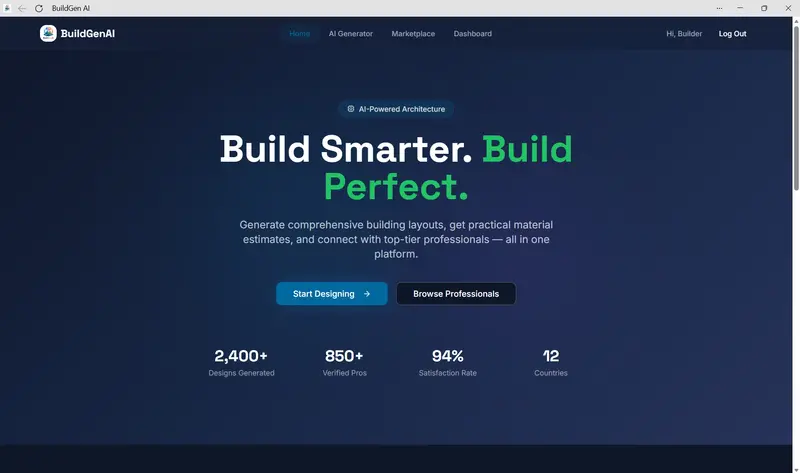
I Finally Revived BuildGenAI: Turning an Unfinished Construction AI Idea Into a Real Product
What I Built
For this challenge, I revived BuildGenAI, a project I had started earlier but never fully completed. The original idea was to create an AI-powered assistant for the construction and home-planning space — something that could help users go beyond just chatting with AI and actually get practical support for planning, estimation, understanding documents, and making better early-stage decisions.
BuildGenAI is built around a simple but meaningful goal: make construction-related guidance more accessible, structured, and easier to understand. In many cases, people who are planning homes, reviewing tenders, estimating materials, or trying to understand compliance-related details do not need another generic chatbot. They need a tool that feels focused on their workflow and gives outputs in a way that is easier to use in real life.
** Before **

** After **
That is the direction I returned to with this project. Instead of letting it remain an incomplete concept, I used this challenge as a reason to finish what I had started and shape the product into something much more presentable. The improved version focuses on turning a rough prototype into a more polished experience with clearer user journeys, better feature structure, and outputs that feel more useful and intentional.
At its core, BuildGenAI is my attempt to bring AI into a domain where clarity matters a lot. Construction planning is expensive, detail-heavy, and full of decisions that can go wrong when people do not have the right guidance early enough. I wanted this project to explore how AI could support that process in a more practical, grounded, and user-friendly way.
Github Copilot Usage
Demo
GitHub Repository: BuildGenAI
Demo Video : https://drive.google.com/file/d/1i_K1RXAL4BsKK8GbsCMUZ0-hwCEOixiI/view?usp=sharing
For the demo section, I am including the project repository and showcasing the revived version through screenshots and/or a walkthrough video. The most important part of this submission is the transformation, so the demo is focused not just on what the app does now, but also on how much stronger and more complete it feels compared to the earlier unfinished version.
This challenge is specifically about showing the comeback, so I wanted the demo to highlight progress, clarity, and completion rather than just listing features. GitHub’s challenge prompt explicitly asks participants to show the before and after and explain how GitHub Copilot helped finish the work.
The Comeback Story
Like many side projects, BuildGenAI started with a strong idea but got stuck before it reached a finished state. The concept was exciting, the direction was promising, and the use case felt meaningful — but the project still had the familiar signs of something unfinished. Parts of the experience were incomplete, some ideas were not fully translated into product flows, and overall it did not yet feel like something ready to be confidently shown as a complete build.
That is what made this challenge a perfect fit.
Instead of starting a new idea from scratch, I decided to revisit BuildGenAI and finally give it the attention it deserved. The first step was not blindly adding more features. It was understanding what the project was lacking. I looked at where the app felt incomplete, where the experience felt confusing, and what parts needed refinement in order to make the product feel coherent.
The biggest shift was moving away from the feeling of a rough prototype and toward the feeling of a usable product. That meant improving structure, clarifying flows, polishing the interface, and thinking more carefully about how the user experiences the app from start to finish. A project can have a good concept and still feel unfinished if the interaction model is weak, the output is messy, or the overall experience lacks direction. That was the gap I wanted to close.
I also wanted the project to feel more focused. Instead of behaving like a generic AI experiment, BuildGenAI needed to feel like a purpose-driven tool. The comeback was really about completing that identity: making it clearer what the project is for, who it helps, and why someone would actually want to use it.
That is the part of finishing a project that often matters most. Completion is not only about writing more code. It is about making the product understandable, cohesive, and ready to stand on its own. This challenge pushed me to do exactly that, and BuildGenAI is much stronger because of it.
What Changed
The revived version of BuildGenAI focuses on polish, usability, and product clarity. The goal was not to overcomplicate the project, but to make the existing idea much more complete and presentable.
Here are the areas I focused on during the revival:
One thing I found especially valuable during this process was realizing that the “finish-up” mindset is very different from the “start-up” mindset. Starting is often driven by excitement. Finishing is driven by decisions. You have to decide what matters, what should be cleaned up, what should be removed, and what actually helps the project feel complete.
That mindset helped me make better choices while revisiting BuildGenAI.
My Experience with GitHub Copilot
GitHub Copilot was genuinely useful in helping me bring BuildGenAI back to life. The value was not just in generating code quickly, but in reducing the friction that usually comes with reopening an older project and trying to move it toward completion.
One of the hardest parts of reviving an unfinished project is momentum. You already know there are gaps, messy areas, and incomplete logic. That can make it surprisingly difficult to re-enter the codebase and make progress. Copilot helped lower that barrier by assisting with repetitive tasks, suggesting implementation patterns, improving flow when refactoring, and helping me move faster through the “cleanup and completion” phase.
It was especially helpful when I wanted to:
For this challenge, Copilot felt less like a shortcut and more like a practical collaborator. It helped me spend less time wrestling with friction and more time improving the actual product experience. Since the challenge specifically emphasizes showing how GitHub Copilot helped finish the project, that became a meaningful part of this revival story as well.
Why I Chose This Project
I chose BuildGenAI because it already had something important: a meaningful problem space. Even in its unfinished state, the idea still felt worth returning to. I did not want to abandon it just because it was incomplete. I wanted to prove to myself that unfinished work still has value if you are willing to revisit it seriously.
This project also reflects the kind of products I enjoy building. I like projects that combine technical implementation with a strong real-world use case. Construction and planning workflows are not always the first area people think about when talking about AI products, which made this project even more interesting to me. It gave me a chance to build something that is not just technically relevant, but also practically useful.
The Finish-Up-A-Thon was the right push at the right time. It gave me a reason to stop treating this as “something I will finish later” and actually turn it into a proper comeback.
Before and After
Before
After
That “before and after” journey is one of the main reasons I wanted to submit this project for the challenge, because the transformation is not just visual — it is also structural, practical, and personal. The official challenge rules and announcement make that completion arc one of the core judging criteria, alongside technology, usability, and originality.
Final Thoughts
This challenge reminded me that unfinished projects are not failures. Sometimes they are just waiting for the right moment, better clarity, and a second round of effort. BuildGenAI started as an idea with potential, got paused before completion, and has now come back as a much stronger version of itself.
For me, that is what this submission is really about. It is not just about shipping code. It is about returning to something unfinished, believing it is still worth building, and doing the work needed to finally bring it closer to completion.
And honestly, that feels more satisfying than starting something new.
Project Link: BuildGenAI
Challenge: GitHub Finish-Up-A-Thon Challenge
Originally published at mrnasdoggrowth.com by MrNasdog.
Most of what’s being written about AI right now is loud.
Loud about how AI will replace everyone. Loud about how AI changes everything. Loud about which AI tool to use this week. Loud about new model releases. Loud about productivity hacks.
The loud strategy is wrong. Not because AI doesn’t matter — it matters more than almost anything else right now. But because the people who’ll win in the next 20 years aren’t going to win by being louder. They’re going to win by being quiet, patient, and deep.
This article is about the quiet strategy. What it looks like, why it works, and how to live it.
Start with the question
The question I want to answer is simple: how do you build a life and career worth having in the next 10 to 20 years, when AI is reshaping everything?
This is a real question. People I talk to are worried about it. They should be. The world is changing fast.
But the answer isn’t to panic, and it isn’t to chase. The answer is to understand where AI is going, where AI structurally can’t go, and to build your life in the second category.
Where AI is going
AI is going to keep getting better at almost everything that involves processing information.
Writing standard documents. Coding common patterns. Synthesizing research. Analyzing data. Generating ideas. Translating. Summarizing. First-draft anything.
Most knowledge work is going to look very different in 10 years. Either AI will do it directly, or one person with AI will do what used to take a team. This isn’t a prediction — it’s already happening. Companies are quietly cutting roles. Solo operators are out-producing teams. The shift is well underway.
If your career is built on doing work AI can also do, you have a problem. Maybe not immediately, but within the planning horizon you care about.
Where AI structurally can’t go
Now the more interesting half.
There’s a class of work AI can’t do well, and won’t be able to do well for decades. This isn’t because AI is bad — it’s because the work itself has properties that don’t fit how AI works.
Think about how AlphaGo beat humans at Go. AlphaGo had three things going for it: it could generate millions of possible moves, it could test those moves quickly in self-play, and every game ended in a clean win or loss.
These three properties — generate, test, evaluate — are what made AI’s victory possible.
Now think about the questions in your actual life. What career to build. Who to spend your years with. What to work on. What kind of person to become.
You can generate possibilities. But you can’t test them in self-play — each possibility requires years of lived experience to evaluate. And there’s no clean win condition — what “winning at life” means is itself the question.
So for the deepest questions, AlphaGo’s approach doesn’t work. AI can list options for you. AI can analyze trade-offs. AI can summarize what worked for other people. But AI can’t tell you what’s right for you specifically, because the testing requires lived time that AI doesn’t have.
This is one structural limit. There are others.
AI’s training data is always behind the present. For fast-moving topics, AI is always slightly outdated. The gap between AI’s knowledge and current reality is real and ongoing.
AI’s best advice loses its edge when distributed. When AI gives you a great strategy, it gives the same strategy to everyone. Strategies that work because they’re rare stop working when they’re shared.
AI doesn’t have a body or a life. It can simulate possibilities but can’t experience consequences. The lived weight of having done something matters in ways AI can’t replicate.
Time-based outcomes can’t be compressed. Some things only become clear after decades of running. AI can model them but can’t accelerate them.
These four limits combined describe the space where humans still have structural advantages over AI. And they don’t move much in 10 or 20 years.
The shape of the quiet strategy
If you understand where AI is going and where AI structurally can’t go, the strategy follows.
You build in the space AI can’t easily enter.
What does that look like in practice?
Pick something specific and stay with it for years. Not weeks. Not months. Years. Deep expertise in a specific domain becomes more valuable as AI commodifies broad knowledge. The specialist beats the generalist as AI rises.
Build a public record over time. Whatever your work is, document it. Make it discoverable. Time-stamp it. The record itself becomes an asset that compounds. Someone with 10 years of public, traceable work in a specific field has something AI can’t replicate — because AI didn’t live those 10 years.
Use AI as a multiplier, not a replacement. Lean on AI for everything AI is good at. Don’t be precious. But don’t let AI make decisions only you can make. Strategy. Values. Direction. Trade-offs. These stay yours.
Take real positions with real stakes. Public predictions. Public investments. Public commitments. The track record matters because it can’t be faked. AI can hypothesize endlessly but can’t be publicly wrong with real consequences.
Pick fields where the present matters more than the past. AI’s training lag is a real disadvantage to AI in fast-moving areas. Stay current, and you stay ahead of what AI can know.
Accept the trade-offs. You have 24 hours a day. You can’t be everything. Pick what matters most to you and commit. The people who try to optimize everything lose to people who commit to specific things deeply.
What this requires
The quiet strategy is harder than the loud strategy in some ways and easier in others.
Harder because it requires patience. You won’t see fast results. You’ll spend years building things that don’t pay off until much later.
Harder because it requires commitment. You can’t keep switching strategies. The compounding only works if you stay with one thing long enough for it to actually compound.
Harder because it requires being unpopular sometimes. Public positions with real stakes mean being publicly wrong sometimes. The people who hedge to avoid being wrong end up with no track record at all.
Easier because it doesn’t require keeping up with every new AI tool release. You don’t need to be the most current. You need to be the most committed.
Easier because it doesn’t require maximum output. You don’t need to publish daily. You need to publish durably. One excellent piece of work that lasts 10 years beats 100 pieces of forgettable content.
Easier because the loud strategy is genuinely a trap. Most loud strategies in the AI era will produce nothing durable. The quiet strategy looks slow but actually wins.
The 20-year view
If you zoom out to 20 years, the picture clarifies.
The people who panicked about AI and tried to compete with it on AI’s terms will mostly lose. AI is too good at AI’s strengths.
The people who refused to use AI will also lose. The productivity advantage of AI-augmented work is too large to ignore.
The people who’ll do well are the ones who used AI heavily for what AI does well, while building patiently in the gaps where AI can’t go. They’ll look ordinary for years. They’ll look slow. They’ll look unimpressive next to people generating massive AI-assisted output.
But in year 15 or year 20, their lived expertise, their documented track record, their identity-anchored work, their patient specific compounding will be obvious. The fast people will have nothing durable to show. The quiet people will have something AI structurally cannot copy.
This is the strategy that actually works for the next 20 years.
It’s not flashy. It doesn’t go viral. It doesn’t lend itself to TikTok hot takes.
But it’s the real game.
Pick something specific. Commit to it for years. Use AI heavily. Build durable assets in the gaps. Take public positions with real stakes. Stay patient.
Do this for the next 10 to 20 years, and you’ll be one of the few people who actually built something while the rest were either replaced by AI or out-competed by people using AI better.
The quiet strategy is the answer. The hard part is having the patience to live it.
Nine years ago, I built an app called Highlander. It was one of those projects you never forget, but over time it broke: old dependencies, outdated tooling, local setup drift, and deployment blockers.
This week, I brought it back to life. Not by rewriting everything from scratch. By pairing with Codex and treating the work like a Product Engineer: fix what matters, unblock users, and ship value fast.
The Problem: The app was frozen in time:
It had been broken long enough that I honestly didn’t expect a quick recovery.
The Approach: Product Engineering, Not Just Refactoring:
I didn’t just “clean code.” I prioritized outcomes:
That sequence mattered more than perfection.
Product Development Context:
This rebuild also reconnects to the original product planning work from the Highlander sprint board on Trello: Highlander product sprint board
That board reflects early MVP scope, feature prioritization, and roadmap thinking. Revisiting the app now with Codex let me combine that original product intent with modern implementation and deployment practices.
What Codex Helped Me Ship:
1) Local revival
2) Demo-ready UX. I added a demo login path directly in the UI.
3) Security hardening. Before deployment, I tightened core risks.
4) Deployment to Fly.io
One of the most important production fixes was removing hardcoded localhost API calls
That one change removed mixed-content/CORS issues on deployed pages.
Why this matters for my career growth:
I’m not making a hard transition away from software engineering. I’m intentionally blending Software Engineer + Product Engineer skills so I can widen my career options and be more valuable to a broader set of teams and employers.
This project reflects that blend:
It wasn’t just a code cleanup. It was an end-to-end product delivery exercise.
What’s Next:
I have another 9-year-old app: Highlander-react-redux. It uses the same backend API, but the frontend is React/Redux. Next, I’m going to use Codex again to revive it with the same Product Engineer lens:
I’ll document that process too, including what worked, what failed, and what changed in my thinking.
Highlander Project
Demo: https://highlander.fly.dev/index.html
Github: https://github.com/heriberto-codes/highlander
Enterprise RAG — A practitioner’s build log | Post 6 of 6
This series has documented a system built to a specific standard: one where access control is enforced before retrieval scoring, where every answer includes traceable citations, and where the evaluation set measures restricted document leakage rather than retrieval relevance alone.
This final post answers the question that matters most for teams considering this as a foundation: what works today, what needs to be in place before this handles real internal documents in a production environment, and what the gap between those two states actually looks like.
What is fully operational today
Every item below runs locally without external dependencies or provider credentials.
Document pipeline:
POST /ingest)Query and access control:
RBAC_blocked_count logged per query — tracks how many chunks were filteredX-API-Key header, preventing request-body role elevationAPI and authentication:
POST /query) with health probes at GET /health
POST /auth/register)POST /api-keys, POST /api-keys/{id}/revoke)ADMIN_TOKEN
Evaluation:
POST /eval/run — calls live query pipeline, not a mocked pathOperational controls:
GET /audit-logs)JSON_LOGS=true)RATE_LIMIT_PER_MINUTE)Infrastructure:
The Azure deployment path
The local runtime maps directly to an Azure deployment topology:
Employee → Microsoft Entra ID
↓
Azure Container Apps: API + Dashboard
↓
Azure AI Search (retrieval)
Azure OpenAI (answer generation)
Azure PostgreSQL or Cosmos DB (metadata + audit logs)
Azure Blob Storage (source documents)
↓
Azure Key Vault (secrets)
Application Insights (logs + metrics)
Switching from local to Azure requires environment variable changes only. No code changes. No schema migrations between SQLite and PostgreSQL — the SQLAlchemy layer handles both. Azure mode fails fast when required AZURE_* settings are missing rather than silently degrading to a local fallback.
What production deployment requires beyond the current implementation
Entra ID or OIDC role derivation from identity claims. The local implementation derives role from API key registration. Production deployment should derive role from authenticated identity token claims — not from request parameters or static key registration. The AUTH_PROVIDER=entra configuration path is implemented. End-to-end validation requires a live Azure tenant.
Semantic or hybrid retrieval. The local lexical retriever is deterministic and validates access control correctly. It does not match the retrieval quality of embedding-based semantic search for queries without token overlap with document chunks. Azure AI Search vector and hybrid query modes are the planned production retrieval path.
Distributed rate limiting. The in-memory rate limiter does not share state across multiple API instances. Horizontal scaling requires Redis-backed or API gateway rate limiting.
PII classification and retention policies. The reference document corpus is synthetic. Before ingesting real internal documents — HR records, finance reports, incident logs — the ingestion pipeline should classify content for PII, apply sensitivity labels, and enforce explicit data retention policies for stored queries and generated answers.
Tenant isolation. The current implementation is single-organization. A deployment serving multiple business units with strict data isolation between them requires a tenant isolation layer at the data model and query pipeline level.
Broader evaluation set. The current evaluation set is calibrated for access-control validation across a small synthetic corpus. A production evaluation set requires human relevance labels, answer correctness checks, and a regression threshold integrated into the CI workflow.
An honest assessment
Enterprise RAG demonstrates the architecture that matters for internal knowledge systems: pre-retrieval access control, citation-backed answers, and an evaluation standard that measures restricted document leakage. The local implementation is complete, testable, and fully reproducible without provider credentials.
The gap to production is real and specific. Entra ID integration, semantic retrieval, distributed rate limiting, PII handling, and tenant isolation are well-understood engineering problems with clear solutions. None of them require rethinking the core pipeline — the access control order, the citation model, and the evaluation structure remain intact.
For a team building an internal document Q&A system: the architecture here is worth adopting. The hardening list above is the production backlog, not a reason to start from scratch.
What I would implement next
The highest-impact single item is Entra ID role derivation in production. The entire value of pre-retrieval access control depends on the role being trustworthy. In a local environment with API key role binding, that trust is reasonable. In a production environment with hundreds of employees, role must come from an authenticated identity provider — not from a manually registered key that may become stale when someone changes teams or leaves the organization.
The concrete step: configure AUTH_PROVIDER=entra, map Entra group claims to retrieval roles, and validate that the role filter receives the correct role from the token rather than from the request body. That single change makes the access control guarantee durable against organizational changes.
One question for you
When an employee changes roles or leaves your organization, how quickly does your internal knowledge system stop serving them documents from their previous role? Is that enforced at the identity provider level or at the document system level?
This concludes the Enterprise RAG build log series.
Full series index