Age Checks Now Read Your Face — But That Still Doesn’t Prove Who You Are

the technical shift toward biometric age estimation is fundamentally changing the landscape for computer vision developers and digital investigators alike. While much of the public discourse focuses on privacy, developers need to look closer at the underlying architecture: we are witnessing a massive deployment of Convolutional Neural Networks (CNNs) optimized for regression rather than classification.

In the world of facial recognition, most of us are used to classification tasks—identifying a specific person by matching a face against a database of known embeddings. However, modern age-gating technology uses a completely different logic. Instead of generating a unique identity token, these models analyze pixel density and facial features—like the depth of nasolabial folds or the texture of the periorbital region—to output a single scalar value: an estimated age.

For developers building investigation technology or biometric modules, the technical implications are massive. According to NIST benchmarking, these systems can achieve a mean absolute error of roughly 1.22 years under controlled conditions. But as any developer who has pushed a CV model to production knows, “controlled conditions” rarely exist in the field. When you move from a clean 1080p web-cam feed to grainy CCTV or a photo taken in low light, that error margin doesn’t just grow; it can render the data useless for forensic purposes.

The critical distinction that developers and investigators must maintain is the difference between age estimation and facial comparison. At CaraComp, we focus on the latter because that is where the evidentiary value lies. Facial comparison isn’t about guessing a category (like age or gender); it is about calculating the Euclidean distance between two high-dimensional facial embeddings to determine the mathematical probability that they represent the same person.

From a codebase perspective, using an age estimation API to “verify” a user is a dangerous shortcut. An age estimation model is trained to find patterns common to a demographic. A facial comparison model is trained to find the minute, unique variances that separate one individual from billions of others. Confusing the two in an investigative report is a fast way to have your evidence thrown out of court.

This is especially relevant for solo private investigators and OSINT researchers who may be tempted to use consumer-grade age-check logs as proof of identity. A log that says “biometric check confirmed: age 25+” is not an identity match. It is a probabilistic guess about a physiological state. It doesn’t use a reference database, and it doesn’t confirm the presence of a specific individual—only that the object in front of the lens possessed features consistent with a specific age bracket.

As we integrate these biometric layers into more applications, we have to be rigorous about the metadata we store and the claims we make. If your system is designed for investigation technology, you should be looking for tools that provide batch comparison and court-ready reports based on Euclidean distance analysis, rather than simple categorical estimation.

When building or implementing these systems, how are you handling the “domain shift” problem—where models trained on high-quality datasets fail when faced with real-world, low-resolution investigative photos?
Hello,guys !

My Name is Npc (Although it’s just a nickname, it’s pretty much the same in real life.)

  • Position: Python Engineer
  • From: China!!
  • Age: 24 (2001-12-25)
  • Education: Associate Degree
  • Major: Big Data Technology (Courses: Java, Python, Apache Hadoop, Scala, Spark, HBase, Hive, Linux, Flink, MySQL, Redis)

Current Technical Stack

python, pytorch, transformers, golang, mysql, redis, pgsql, mongodb, elasticsearch, clickhouse

Awards

First Prize in Provincial Big Data Skills Competition (Associate Degree Level)

Hobbies

FPV Drones, Fixed-wing Model Aircraft, Programming.

University Learning Experience:

  • Year 1: Confused and blank, little social experience, loved gaming, 70% course absorption rate, no self-directed learning habits outside class.
  • Year 2: Sudden growth, mindset restructured, clearly recognized this was my last usable time, formulated (Python) learning plan, surpassed school curriculum the same year.
  • Year 3: Pandemic arrived, studied from home, used self-taught Python web scraping knowledge to acquire data, learning drive skyrocketed, advanced to self-directed learning of big data analysis content (Java, Scala, Spark, HBase, Hive, Flink), surpassed all classmates the same year.

Career Experience:

  • Phase 1: Interned in Shanghai from Guangdong, learned mainstream big data analysis projects (Spark-type), worked on the front line contacting massive industry data analysis demands, self-study research continued, pandemic worsened, internship ended early in less than 1 year.
  • Phase 2: Big data technology heat declined, SMEs turned to cooperate with large data service providers to reduce costs, entered large data service provider in Shenzhen, Guangdong (Python data scraping and analysis type), self-study research continued but already understood industry big data status (SMEs don’t need big data | Data service providers rising | Data more important than technology | Positions shrinking, SME position survival rate low)
  • Phase 3: Demand continued to decrease -> Big data technology became auxiliary, effectively transitioned to API data service interface docking as main work, same year jumped to tourism industry technical service provider, big data technology + data scraping analysis experience advantage emerged, brought innovation, focused on data collection + hotel business data analysis aggregation algorithms (traditional engineering algorithms).
  • Phase 4: Data collection + hotel business data analysis business demand continued to rise, simultaneously API data service interface auxiliary increased, finally remaining continuous learning technical stack: (python, golang, mysql, redis, pgsql, mongodb, elasticsearch, clickhouse).
  • Phase 5: AI explosion (ChatGPT debuted), first batch of experience users, once again developed strong interest in emerging sector, deep research and exploration.
  • Phase 6 (Now):

    1. Researching current hotel physical information aggregation algorithm transformation to AI, deeply understanding AI development history (CUDA/RNN/CNN/TensorFlow/Torch/Transformers), cutting in from code layer to understand PyTorch & Transformers (decoder-only/encoder-only/decoder-encoder)
    2. Attempted to access hotel physical information aggregation business from AI application layer, generalization ability improved but accuracy uncontrollable, optimized prompts -> still uncontrollable, essential reasons (attention problems | hallucinations | generative models and clustering tasks not compatible | high cost slow speed | knowledge base cannot guarantee consistent retrieval results each time | uncertain results inherently incompatible with this business (unacceptable error rate))
    3. Abandoned AI application layer API, made progress from encoder-only layer (vertical domain fine-tuning) experiments, (effective without hallucinations | 10,000 retry results consistently correct | generalization ability acceptable (compared to previous engineering algorithms, significant improvement) | fast speed low cost (actually slow and high cost compared to previous engineering algorithms, but for LLM it’s already very fast and cheap))
    4. Encoder-only vertical domain fine-tuning continues, simultaneously continuing deep learning of decoder-only principles (understanding why this works? why this doesn’t work?), rather than understanding surface-level principles from existing (finished APIs/open-source models), I feel I need to understand more thoroughly from the bottom layer, even if theoretical knowledge occupies 70% and code knowledge occupies 30%, I believe this is a very efficient learning ratio, this is a learning method that lives and dies with AI, organized sufficient theoretical knowledge can let AI generate code knowledge, we then modify and experiment to achieve final requirements (this is not me over-relying on AI, if AI dies, then this knowledge dies too, of course I believe this conceptual knowledge exists forever and is great), so I call this progressive learning, different from previous learning methods.
    5. Continuously updating (those who lie usually forget)….

I also hope my learning speed can surpass the pace of obsolescence, rather than being eliminated and then starving to death beside a trash can…

RideShield! Phase 2

RideShield Phase 2: Automation, Protection & Mobile Power

After successfully building the foundation in Phase 1, RideShield now enters Phase 2: Automation & Protection — with a major leap forward:

📱 The RideShield Mobile App is officially here.

This phase transforms RideShield into a real-world, always-on safety net for gig workers — accessible anytime, anywhere.

📱 Mobile App Launch: Protection in Your Pocket

Gig workers are always on the move — so RideShield had to move with them.

With the new mobile app, riders can now:

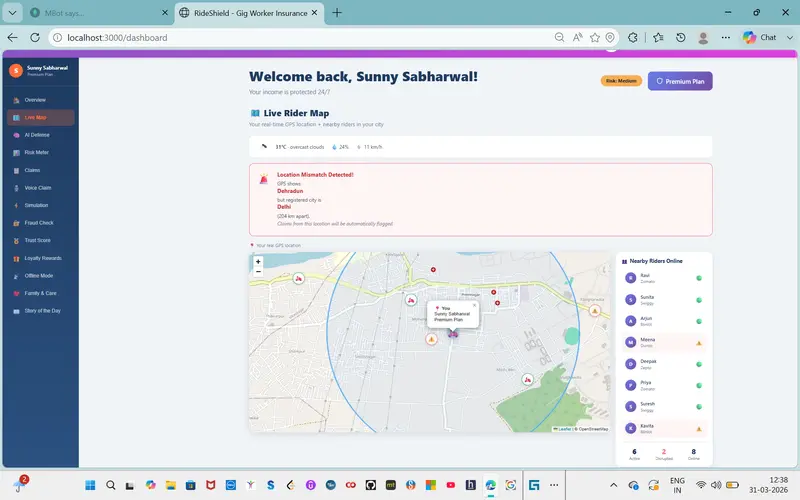
📍 Track live disruptions based on their exact GPS location
🎙️ File voice-based claims in Hindi & English
🔔 Receive instant alerts for weather risks & payouts
💸 Monitor real-time payout status
📡 Submit claims even offline (auto-sync enabled)

👉 No laptops. No delays. Just instant protection — right from their phone.

⚡ What’s New in Phase 2?
We’ve upgraded RideShield into a fully automated, intelligent platform:

🔐 Secure Auth (JWT + MongoDB Atlas)
💰 AI Dynamic Pricing (6 Smart Plans)
🌦️ Hyperlocal Weather Intelligence (GPS-based)
🗺️ Live Map with Nearby Riders
📩 Auto Family Alerts on Disruptions
🧠 AI-Powered Protection System

RideShield now runs on a powerful intelligence layer:

🤖 AI Risk Scoring Engine (ML-based pricing + predictions)
🛡️ AI Defense Engine
Geo-fencing
Sensor fusion
Zero-trust system
Anomaly heatmaps
🚫 Location Fraud Detection (GPS vs registered city)
💸 Smarter Claims, Zero Effort

We’ve taken automation to the next level:

⚡ Auto-triggered claims (rain, heat, AQI, restrictions)
🎙️ Voice-enabled claim system
📊 Dynamic payout calculation
💸 Animated payout timeline for transparency

👉 No paperwork. No waiting. No confusion.
🌟 Rider Experience Upgrades

We didn’t just build tech — we improved experience:

⭐ Trust Score & Loyalty Rewards
🧪 Simulation Mode (5-step disruption demo)
📖 Story of the Day (real rider stories)
🔔 Real-time notification system
📊 12-tab smart dashboard
🤖 Fully Automated Ecosystem

Phase 2 delivers a true

📡 5+ automated disruption triggers using APIs
📊 ML-based premium adjustment
⚙️ Seamless backend automation
📱 Mobile-first accessibility

🔮** What’s Next?**

With Phase 2 complete, RideShield is ready to scale:

🌍 Expansion to 50+ cities
🤝 Integration with gig platforms (Zomato, Swiggy)
📈 Advanced AI prediction models
💳 Faster and smarter payout systems

❤️ Final Thought

Gig workers power our everyday lives — delivering food, essentials, and convenience.

RideShield ensures they’re protected when the unexpected hits.

📱 With our mobile app + AI automation, protection is now:
Instant. Intelligent. Invisible.

Link will be available soon.

Article: Event-Driven Patterns for Cloud-Native Banking: Lessons from What Works and What Hurts

Event-driven architecture helps banks decouple systems, scale services, and create clear activity trails. But it also introduces complexity, new failure modes, and operational challenges. Chris Tacey-Green explains where it adds value in banking systems and the practical patterns, such as inbox/outbox and stable event contracts, needed to make it reliable.

By Chris Tacey-Green

Podcast: Failure As a Means to Build Resilient Software Systems: A Conversation with Lorin Hochstein

In this podcast Michael Stiefel spoke to Lorin Hochstein about how real-world failures provide insight into how software systems actually work. Our first topic was understanding that while automated fault injection tools can introduce basic robustness into a system, they cannot replicate the understanding that comes from mitigating complicated software failures in the real world.

By Lorin Hochstein

QCon London 2026: Team Topologies as the ‘Infrastructure for Agency’ with AI

At QCon London 2026, Matthew Skelton argued that AI success depends on organisational maturity. He highlighted bounded agency, security, and stewardship as key to managing AI agents. By using Innovation and Practices Enabling Teams, companies can drive knowledge diffusion and optimise internal processes to see real-world returns on their AI investments.

By Mark Silvester