LLM APIs for AI Agents: Anthropic vs OpenAI vs Google AI (AN Score Data)

LLM APIs for AI Agents: Anthropic vs OpenAI vs Google AI (AN Score Data)

Every agent framework tutorial says “add your OpenAI API key.” But if you’re building an agent system for production — not a demo — the choice of LLM API matters more than the marketing suggests.

Anthropic, OpenAI, and Google AI have meaningfully different API designs. Those differences show up when your agent needs to recover from a rate limit, handle a tool-use error, or navigate auth complexity without human help.

Rhumb scores LLM APIs the same way it scores payment APIs: 20 dimensions, weighted for agent execution. Here’s what the data shows.

TL;DR

API AN Score Confidence Best for
Anthropic 8.4 64% Tool-using agents, structured output, execution reliability
Google AI 7.9 62% Multimodal, long-context, cost-sensitive workloads
OpenAI 6.3 98% Ecosystem breadth, fine-tuning, multi-modal in one provider

Note: OpenAI’s 98% confidence means the gap between its score and the others is the most statistically reliable of the three. The 2.1-point gap between first and third represents materially different agent experiences.

Anthropic: 8.4 — Agent-First API Design

Execution: 8.8 | Access Readiness: 7.7

Anthropic’s tool-use interface was built for agents from day one. The function-calling format is consistent. Error responses are structured and actionable. The API surface is intentionally focused — no image generation, no audio — which means what it does, it does well.

Where Anthropic creates friction:

  • Rate limits can tighten faster than agents expect under load — adaptive backoff is required, not fixed delays
  • Model deprecation cycles happen; agents pinned to a specific version need a fallback path
  • Narrower scope (no image gen, no fine-tuning) means a second integration if you need a full-stack provider

Pick Anthropic when execution reliability and agent-friendly API design matter more than ecosystem breadth.

Google AI: 7.9 — Multimodal Depth, Surface Confusion

Execution: 8.3 | Access Readiness: 7.2

Google AI’s execution score (8.3) nearly matches Anthropic’s. Strong structured output, solid error handling, and generous free-tier access. The catch: Google has three overlapping product surfaces — AI Studio, Vertex AI, and the Gemini API — and an agent has to pick the right door before it can make its first call.

Where Google AI creates friction:

  • Three overlapping products mean the agent must determine which endpoint to use — picking wrong means re-doing auth
  • Moving from free-tier API keys to production service accounts is a significant complexity jump
  • Model naming differs across the three surfaces, so code built against AI Studio may not port cleanly to Vertex

Pick Google AI when multimodal breadth, long-context processing, or cost-sensitive workloads are the primary concern.

OpenAI: 6.3 — The Ecosystem Premium Has a Price

Execution: 7.1 | Access Readiness: 5.5 | Autonomy: 7.0

OpenAI’s 6.3 is the most well-measured score of the three (98% confidence). The gap is real. The access readiness score (5.5) reflects a multi-step setup burden that other providers skip: organization creation, project keys, spend-gated rate tiers, and multiple overlapping API surfaces (Chat Completions, Assistants API, Responses API).

An agent starting fresh with OpenAI starts at the lowest rate limits regardless of technical need, and has to navigate organizational hierarchy before making its first production call.

Where OpenAI creates friction:

  • Organization/project key hierarchy adds mandatory setup steps — other providers issue one key and go
  • Rate limits tier by historical spend: new agents start throttled even at low workloads
  • Multiple API surfaces (Chat Completions vs Assistants vs Responses) create version confusion

Pick OpenAI when ecosystem breadth and model variety (text + image + audio + fine-tuning) outweigh onboarding friction.

The Friction Map

The scores compress nuance. Here’s what actually breaks in practice:

Anthropic: Rate limit adaptive backoff is non-optional at scale. Model version pinning needs explicit handling or agents silently change behavior on deprecation.

Google AI: The three-surface problem is real. An agent built against AI Studio auth will need re-architecture for Vertex production deployment. Plan for this upfront.

OpenAI: The spend-gated rate limit tier is the biggest hidden cost. A well-funded agent pipeline may tier up quickly, but a new integration starts throttled — and that throttling is invisible until you hit it.

The Wider Field

Rhumb scores 10 LLM/AI providers. The full leaderboard includes:

  • Groq 7.5 — fastest inference
  • xAI Grok 7.4 — real-time web access
  • Mistral 7.3 — EU sovereignty
  • DeepSeek 7.1 — cost efficiency

View the full AI/LLM leaderboard →

How These Scores Work

Rhumb AN Score evaluates APIs from an agent’s perspective — not a human developer’s.

  • Execution (70% weight): Error specificity, idempotency, retry safety, rate limit predictability, schema stability
  • Access Readiness (30% weight): Auth ergonomics, sandbox completeness, onboarding friction, key management

Scores are live and change as providers ship improvements. OpenAI’s access score would improve significantly if organization setup were simplified or rate limit tiers were decoupled from spend history.

Full methodology: rhumb.dev/blog/mcp-server-scoring-methodology

View live AI/LLM scores on rhumb.dev →

Scores reflect published Rhumb data as of March 2026. AN Scores update as provider capabilities change.

Payment APIs for AI Agents: Stripe vs Square vs PayPal (AN Score Breakdown)

Payment APIs for AI Agents: Stripe vs Square vs PayPal (AN Score Breakdown)

When your agent needs to charge something, the stakes are different from a human clicking Pay Now.

There is no human in the loop. The agent has to reason about payment state, handle retries cleanly, interpret errors without escalating to a person, and do it all without leaking funds or creating duplicate charges.

The payment API you pick determines whether that goes smoothly or whether your agent calls POST /charges three times because it could not tell the difference between a network timeout and a declined card.

Rhumb scores payment APIs on 20 dimensions across execution reliability, access readiness, and payment autonomy. Here is what the data says about the three most commonly evaluated options.

TL;DR

API AN Score Tier Best for
Stripe 8.1 L4 Native Default. Software-native agents, subscriptions, developer products
Square 6.3 L2 Ready Physical commerce, omnichannel, location-aware agents
PayPal 4.9 L1 Developing PayPal-native buyer demand or specific payout constraints only

Stripe: 8.1 — The Default

Execution: 9.0 | Access Readiness: 6.6 | Payment Autonomy: 10.0

Stripe earns a 10 on payment autonomy because it was built for programmatic use from day one. Idempotency keys are first-class. Errors are structured and specific. Webhooks are versioned. Retry safety is designed in, not bolted on.

For an agent, this matters a lot. The difference between “payment accepted” and “payment timeout with unknown final state” is the difference between a successful transaction and a support ticket.

Where Stripe creates friction:

  • Restricted key scope can return empty results instead of explicit permission errors — agents need to be scoped correctly or they will make wrong inferences
  • Webhook payload shape can drift if endpoint versions are not pinned — agents relying on specific field structure need defensive parsing

The 3am test: If your agent queues a payment job at 3am and the network blips, does the charge happen once or twice? With Stripe idempotency plus structured error responses, you can write retry logic that answers this correctly.

Pick Stripe unless you have a specific reason not to.

Square: 6.3 — The Physical Commerce Specialist

Execution: 7.3 | Access Readiness: 5.2 | Payment Autonomy: 6.0

Square’s lower score is not a product failure — it is a structural tradeoff. Square was built for the intersection of physical and software commerce. If your agent manages inventory, locations, catalogs, and point-of-sale operations alongside payments, Square’s data model is actually richer than Stripe for that use case.

Where Square creates friction:

  • Merchant onboarding (KYC/KYB) cannot be fully automated — agents hit a human-required step before production access
  • Rate limits are conservative enough that naive batching needs explicit backoff
  • Less agent-shaped permissioning than Stripe restricted key model

The 3am test: An agent managing a physical store across locations, inventory, and omnichannel fulfillment — Square handles that state correctly. Stripe does not.

Pick Square when location, catalog, or omnichannel operations are part of the agent job.

PayPal: 4.9 — The Constraint-Driven Choice

Execution: 5.9 | Access Readiness: 3.7 | Payment Autonomy: 5.0

PayPal’s 4.9 score reflects accumulated complexity from its human-era design. The payment state machine has more transitions than Stripe’s. Business account verification creates unavoidable human setup steps. Dashboard ergonomics do not translate cleanly to programmatic flows.

This does not mean PayPal cannot work in an agent pipeline. It means you are absorbing more complexity to make it work.

Where PayPal creates friction:

  • Order lifecycle is more stateful and approval-heavy — agents manage more transitions before money settles
  • Business verification complexity creates more human-required setup than the Stripe path
  • Access readiness score (3.7) reflects older API surfaces that require more defensive handling

The 3am test: Agent needs to process a PayPal payment in a market where PayPal buyer trust matters. That is the only scenario where PayPal scores better than the alternatives.

Pick PayPal only when your distribution strategy requires it.

Why Execution Score Matters More Than Price

A common mistake: choosing a payment API based on per-transaction fees without accounting for the cost of agent-side complexity.

Every percentage point of execution uncertainty — ambiguous error codes, non-idempotent endpoints, state machines with undefined transitions — translates into engineering hours, retry logic, and edge cases.

Stripe’s 9.0 execution score is not marketing. It is a measurement of how many of those edge cases do not exist.

The Framework

Rhumb AN Score evaluates APIs on 20 dimensions:

  • Execution score (70% weight): Error specificity, idempotency, retry safety, rate limit predictability, schema stability
  • Access readiness (30% weight): Auth ergonomics, sandbox completeness, onboarding friction, key management

Payment autonomy is a sub-dimension for payment-specific APIs measuring the ability for agents to complete payment operations without human intervention at each step.

Full scoring methodology: rhumb.dev/blog/mcp-server-scoring-methodology

Full payment leaderboard (Adyen, Braintree, Lemon Squeezy, and more): rhumb.dev/leaderboard

Scores reflect published Rhumb data as of March 2026. View live payment scores on rhumb.dev

Talent Oversupply: How Less Prestigious Firms Can Attract Top-Tier Candidates Amid Economic Shifts

System Reconstruction: Talent Oversupply Dynamics

The current job market is undergoing a seismic shift, driven by economic downturns, industry-specific layoffs, and the normalization of remote work. This has created an unprecedented talent oversupply, particularly in sectors like tech, where highly qualified individuals are now seeking alternative employment. For businesses, this presents a unique opportunity to acquire top-tier talent at reduced costs. However, this trend is not without its pitfalls, as both employers and employees face long-term risks if strategic planning is overlooked.

Mechanisms Driving Talent Oversupply

1. Talent Supply and Demand Dynamics

Impact → Internal Process → Observable Effect

Economic downturns or industry-specific layoffs (e.g., tech) increase talent supply → Excess talent seeks alternative employment → Highly qualified candidates apply to less prestigious roles.

Analysis: This mechanism underscores the immediate benefit for employers, who can now access talent pools previously out of reach. However, it also highlights the risk of talent-role mismatch, as top-tier candidates settle for positions below their skill level.

2. Talent Redistribution Channels

Impact → Internal Process → Observable Effect

Remote work policies and economic pressures reduce geographic/industry barriers → Talent migrates across sectors and tiers → Less prestigious firms receive applications from top-tier candidates.

Analysis: The breakdown of traditional barriers allows smaller firms to compete for elite talent. Yet, this redistribution may be temporary, as geographic and cultural barriers could re-emerge post-downturn, limiting long-term retention.

3. Employer Hiring Strategies

Impact → Internal Process → Observable Effect

Oversupply of talent lowers hiring costs → Employers hire experienced candidates for traditionally entry-level roles → Mismatch between talent and role emerges.

Analysis: While cost savings are immediate, hiring overqualified candidates for entry-level roles can lead to dissatisfaction and attrition, undermining team stability and productivity.

4. Employee Career Decision-Making

Impact → Internal Process → Observable Effect

Economic uncertainty shifts priorities to stability → Highly qualified individuals accept less prestigious roles → Short-term hires with high turnover expectations.

Analysis: Employees prioritize job security over career advancement, but this short-term focus risks long-term career stagnation and devaluation of their skill sets.

5. Market Signaling and Perception

Impact → Internal Process → Observable Effect

Presence of top-tier talent in less prestigious roles signals market anomaly → Employers perceive opportunity for opportunistic hiring → Increased short-term hiring with uncertain retention.

Analysis: The anomaly of top talent in lower-tier roles encourages opportunistic hiring, but this approach may backfire as retention becomes uncertain once the market stabilizes.

System Instabilities and Long-Term Risks

1. Talent-Role Mismatch

Overqualified candidates in underutilized roles lead to dissatisfaction → Increased attrition → Disrupts team stability and productivity.

Analysis: Mismatches not only reduce employee morale but also create inefficiencies, as teams struggle to integrate and retain overqualified individuals.

2. Short-Term Hiring Focus

Prioritizing cost savings over retention creates knowledge gaps → Turnover leads to productivity losses → Long-term organizational inefficiency.

Analysis: While short-term cost savings are appealing, the cumulative effect of turnover and knowledge loss can erode organizational efficiency over time.

3. Remote Work Dependency

Reliance on remote work policies limits talent retention → Geographic/cultural barriers re-emerge post-downturn → Reduced access to redistributed talent.

Analysis: Remote work policies, while beneficial during downturns, may not sustain talent retention once economic conditions improve, leaving firms vulnerable to talent flight.

4. Market Correction Whiplash

Rapid shifts in talent supply lead to overcorrection → Recovering industries face talent shortages → Cyclical instability in talent distribution.

Analysis: The pendulum swing from oversupply to shortage creates cyclical instability, making it difficult for businesses to maintain consistent talent pipelines.

Process Mechanics

Process Physics/Logic
Talent Supply Increase Layoffs → Excess labor pool → Supply exceeds demand in certain sectors.
Talent Redistribution Remote work + economic pressure → Reduced barriers → Cross-industry migration.
Employer Opportunism Surplus talent → Lower hiring costs → Short-term optimization over long-term retention.
Employee Risk Aversion Economic uncertainty → Priority shift to stability → Acceptance of suboptimal roles.
Market Signaling Anomaly detection → Opportunistic behavior → Amplification of short-term hiring trends.

Conclusion: Navigating the Talent Oversupply Landscape

The current talent oversupply presents a rare opportunity for businesses to acquire top-tier talent at reduced costs. However, this opportunity is fraught with risks, including talent-role mismatches, high turnover rates, and long-term organizational inefficiencies. Employers must balance short-term gains with strategic long-term planning, focusing on retention and role alignment. Similarly, employees must weigh the immediate benefits of job security against the potential for career stagnation. Without careful navigation, this trend could exacerbate cyclical instability in the job market, leaving both parties vulnerable to future disruptions.

System Mechanisms and Dynamics

1. Talent Supply and Demand Dynamics

Impact: Economic downturns or industry-specific layoffs (e.g., tech) trigger a surge in the labor pool, creating an oversupply of highly qualified candidates. This phenomenon is particularly pronounced in sectors experiencing rapid contraction, forcing top-tier talent to compete for roles traditionally considered less prestigious.

Internal Process: The excess supply of talent drives down hiring costs and increases the availability of skilled workers. Employers, recognizing the opportunity, adopt opportunistic selection strategies, often hiring candidates who exceed role requirements.

Observable Effect: Highly qualified individuals accept positions below their skill level, leading to a mismatch between talent and role expectations. This trend is a direct consequence of the cyclical nature of job markets, which alternates between oversupply and undersupply, creating systemic unpredictability.

Analytical Insight: While this dynamic offers employers short-term cost advantages, it poses long-term risks. Overqualified employees may feel underutilized, leading to dissatisfaction and higher attrition rates once market conditions improve. This instability underscores the need for strategic workforce planning to balance immediate gains with future retention challenges.

2. Talent Redistribution Channels

Impact: The rise of remote work policies, coupled with economic pressures, has dismantled traditional geographic and industry barriers. This shift enables cross-industry migration of top-tier talent to firms previously considered less prestigious or geographically inaccessible.

Internal Process: Remote work infrastructure facilitates talent mobility, allowing employers to tap into a broader talent pool. However, this dependency on digital connectivity also introduces vulnerabilities, as the re-emergence of geographic or cultural barriers post-downturn can disrupt redistribution patterns.

Observable Effect: Elite talent from prestigious companies increasingly joins less prominent firms, driven by the flexibility of remote work and the need for job security. This migration reshapes industry hierarchies and challenges traditional notions of organizational prestige.

Analytical Insight: The redistribution of talent presents a unique opportunity for businesses to acquire high-caliber employees. However, the sustainability of this trend hinges on the continued viability of remote work infrastructure. Employers must invest in robust digital ecosystems to retain talent post-recovery, or risk losing these individuals to more prestigious firms once barriers re-emerge.

3. Employer Hiring Strategies

Impact: Talent oversupply empowers employers to adopt opportunistic hiring strategies, leveraging lower costs to select candidates with qualifications exceeding role requirements.

Internal Process: The focus shifts from long-term fit to short-term cost savings, as employers prioritize immediate productivity gains over strategic workforce alignment. This approach often results in overqualified candidates filling entry-level or mismatched roles.

Observable Effect: While hiring costs decrease, the mismatch between talent and role expectations creates inefficiencies. Overqualified employees may feel unchallenged, leading to dissatisfaction and increased turnover once market conditions stabilize.

Analytical Insight: The short-term benefits of opportunistic hiring must be weighed against the long-term risks of talent underutilization. Employers risk creating knowledge gaps and productivity losses if top talent departs after the market recovers. To mitigate this, businesses should align hiring strategies with long-term organizational goals, ensuring roles offer growth opportunities for high-potential employees.

4. Employee Career Decision-Making

Impact: Economic uncertainty prompts employees to prioritize job stability over career advancement, leading to the acceptance of suboptimal roles with high turnover expectations.

Internal Process: Faced with limited options, individuals trade long-term career growth for immediate security. This shift in priorities reflects a survival mindset, where short-term stability outweighs the pursuit of fulfilling roles.

Observable Effect: Employees settle for positions that fail to leverage their full potential, increasing the risk of career stagnation and burnout. This trend amplifies attrition rates, as individuals seek better opportunities once market conditions improve.

Analytical Insight: The acceptance of suboptimal roles creates a paradox: while employees gain temporary security, they risk devaluing their long-term career prospects. This dynamic underscores the need for individuals to balance immediate needs with strategic career planning. Employers, meanwhile, must recognize the transient nature of this talent pool and invest in retention strategies that foster long-term engagement.

5. Market Signaling and Perception

Impact: The presence of top talent in lower-tier roles signals a market anomaly, prompting employers to adopt opportunistic short-term hiring strategies.

Internal Process: Businesses detect the availability of high-caliber candidates at reduced costs and respond by accelerating hiring efforts. However, this approach often overlooks the long-term fit between talent and organizational culture.

Observable Effect: Employers capitalize on the anomaly, but the retention of these individuals remains uncertain post-market stabilization. The mismatch between talent and role expectations can lead to organizational inefficiency and increased turnover.

Analytical Insight: The current market anomaly presents a double-edged sword for employers. While it offers unprecedented access to top talent, the lack of strategic alignment risks creating organizational friction. Businesses must balance opportunistic hiring with a focus on cultural fit and long-term retention to maximize the value of this talent influx.

System Constraints and Failure Modes

Constraints

  • Economic Cycles: The inherent cyclicality of job markets drives alternating periods of oversupply and undersupply, limiting long-term predictability. This volatility challenges both employers and employees to adapt to rapidly changing conditions.
  • Industry-Specific Shocks: Layoffs in specific sectors (e.g., tech) create a specialized talent surplus, constraining cross-industry mobility. This concentration of talent in certain fields limits opportunities for diversification.
  • Remote Work Infrastructure: While acting as an enabler, reliance on remote work infrastructure increases vulnerability to post-downturn barriers. The re-emergence of geographic or cultural constraints can disrupt talent redistribution.
  • Startup Ecosystem Health: Funding availability directly impacts the ability of startups to attract and retain top talent during downturns. A weakened ecosystem limits opportunities for innovation and growth.
  • Employee Turnover Costs: High turnover rates disrupt team stability and increase operational costs. The loss of skilled employees undermines organizational efficiency and long-term competitiveness.

Typical Failures

  • Talent-Role Mismatch: Overqualified candidates often experience underutilization, leading to dissatisfaction and attrition. This mismatch wastes valuable human capital and creates inefficiencies.
  • Short-Term Focus: Prioritizing immediate cost savings over long-term strategic alignment results in knowledge gaps and productivity losses. This approach undermines organizational resilience and growth potential.
  • Talent Burnout: Acceptance of suboptimal roles leads to disillusionment and performance decline. Burnout exacerbates attrition rates and disrupts team dynamics.
  • Market Correction Whiplash: Rapid shifts in market conditions can lead to overcorrection, causing talent shortages in recovering industries. This volatility creates additional challenges for workforce planning.
  • Cultural Misalignment: Elite talent often struggles to adapt to less prestigious organizational cultures, leading to friction and reduced productivity. This mismatch highlights the importance of cultural fit in talent retention.

Conclusion: Navigating the Talent Paradox

The current job market presents a paradoxical opportunity for businesses: the ability to acquire top-tier talent at reduced costs, coupled with the risk of long-term instability. While economic downturns and industry-specific shocks have created an oversupply of highly qualified candidates, this trend is inherently transient. Employers must balance opportunistic hiring with strategic workforce planning to mitigate the risks of talent-role mismatch, turnover, and organizational inefficiency.

For employees, the acceptance of suboptimal roles offers temporary security but threatens long-term career prospects. Individuals must navigate this landscape with a focus on strategic career planning, balancing immediate needs with future growth opportunities.

Ultimately, the ability to capitalize on this unique talent migration hinges on recognizing its short-lived nature and implementing proactive strategies to foster retention, alignment, and sustainability. Both employers and employees must act decisively to transform this moment of instability into a foundation for long-term success.

System Mechanisms and Dynamics

Talent Supply and Demand Dynamics

Economic downturns or industry-specific layoffs, particularly in sectors like tech, significantly expand the labor pool, creating an oversupply of qualified candidates. This supply surge directly reduces hiring costs, enabling employers to recruit overqualified talent at a lower premium. However, this short-term advantage often results in talent-role mismatches, where employees are underutilized. Such mismatches foster long-term dissatisfaction and elevate attrition risks, undermining organizational stability. Intermediate Conclusion: While oversupply offers immediate cost benefits, it introduces systemic inefficiencies that threaten future productivity.

Talent Redistribution Channels

Remote work policies and economic pressures have dismantled traditional geographic and industry barriers, facilitating cross-industry talent migration. Consequently, top-tier candidates from prestigious firms are increasingly joining less prominent organizations, reshaping industry hierarchies. However, this redistribution is often temporary, as post-downturn conditions may reintroduce barriers, prompting talent to revert to higher-tier firms. Intermediate Conclusion: The democratization of talent access is fleeting, necessitating strategic retention efforts to sustain competitive advantage.

Employer Hiring Strategies

In response to talent oversupply, employers prioritize short-term cost savings by hiring overqualified candidates without assessing long-term fit. This approach exacerbates role mismatches, leading to operational inefficiencies and heightened turnover rates. Intermediate Conclusion: Opportunistic hiring undermines organizational resilience, as short-term gains are offset by long-term instability.

Employee Career Decision-Making

Economic uncertainty shifts employee priorities from career advancement to job stability, prompting acceptance of suboptimal roles. This risk-averse behavior increases the likelihood of career stagnation, burnout, and eventual attrition. Intermediate Conclusion: Employees’ focus on immediate security jeopardizes their long-term career prospects, creating a cycle of underachievement.

Market Signaling and Perception

The presence of top talent in lower-tier roles signals a market anomaly, prompting employers to adopt short-term hiring strategies that overlook long-term fit. This misalignment results in uncertain retention post-stabilization, perpetuating inefficiency and turnover. Intermediate Conclusion: Market anomalies incentivize tactical hiring, but this approach fails to address structural retention challenges.

System Instabilities

  • Talent-Role Mismatch: Overqualified candidates in underutilized roles experience dissatisfaction, driving attrition and disrupting team cohesion. This mismatch undermines organizational performance and exacerbates recruitment costs.
  • Short-Term Hiring Focus: Prioritizing cost savings over strategic fit creates knowledge gaps and productivity losses, eroding long-term efficiency and competitive positioning.
  • Remote Work Dependency: Overreliance on remote work increases vulnerability to post-downturn barriers, such as geographic and cultural constraints, limiting talent retention.
  • Market Correction Whiplash: Rapid shifts in talent supply lead to overcorrection, causing cyclical instability in recovering industries and hindering sustained growth.

Intermediate Conclusion: Systemic instabilities stemming from short-term strategies threaten organizational resilience and market stability, requiring proactive mitigation.

Process Mechanics

Talent Supply Increase

Layoffs generate an excess labor pool, surpassing demand in specific sectors. This surplus enables employers to capitalize on reduced hiring costs but introduces risks of role mismatches and long-term inefficiencies.

Talent Redistribution

Remote work and economic pressures eliminate traditional barriers, enabling cross-industry talent migration. While this democratizes access to top talent, the redistribution is often temporary, as post-downturn conditions may reverse the trend.

Employer Opportunism

A surplus of talent allows employers to optimize short-term costs by hiring overqualified candidates. However, this approach prioritizes immediate savings over retention, fostering systemic inefficiencies.

Employee Risk Aversion

Economic uncertainty drives employees to prioritize stability over career growth, leading to acceptance of suboptimal roles. This behavior increases the risk of stagnation, burnout, and eventual attrition.

Market Signaling

The presence of top talent in lower-tier roles amplifies short-term hiring trends, as employers exploit transient conditions. However, this anomaly detection fails to address long-term retention challenges, perpetuating instability.

Analytical Synthesis and Implications

The current job market presents an unprecedented opportunity for businesses to acquire top-tier talent at reduced costs. However, this trend is short-lived and carries significant risks. Employers risk high turnover rates as top talent departs once market conditions stabilize, while employees face career stagnation or role mismatches that devalue their long-term prospects. Final Conclusion: To capitalize on this opportunity sustainably, businesses must adopt strategic hiring practices that balance short-term gains with long-term retention, ensuring both organizational resilience and employee fulfillment.

System Mechanisms and Dynamics

1. Talent Supply and Demand Dynamics

Impact: Economic downturns or industry-specific layoffs significantly expand the labor pool, creating a temporary oversupply of highly qualified candidates. This phenomenon is particularly pronounced in sectors experiencing rapid technological disruption or regulatory shifts.

Internal Process: The oversupply of talent drives down hiring costs, enabling employers to recruit overqualified candidates at lower salary premiums. This opportunistic hiring strategy is often driven by short-term cost optimization rather than long-term strategic fit.

Observable Effect: Talent-role mismatches become prevalent, as overqualified individuals are placed in positions that underutilize their skills. This leads to long-term dissatisfaction, elevated attrition risks, and reduced organizational stability, undermining productivity and team cohesion.

Analytical Insight: While the immediate cost savings are attractive, the long-term consequences of talent mismatches pose a strategic risk. Employers must balance short-term gains with the need for sustainable talent alignment to avoid cyclical inefficiencies.

2. Talent Redistribution Channels

Impact: The rise of remote work and economic pressures have accelerated cross-industry talent migration, breaking down traditional barriers to mobility. This trend is further amplified by the normalization of hybrid work models.

Internal Process: Remote infrastructure facilitates talent mobility but introduces vulnerabilities, particularly during post-downturn recovery phases. Employers in less prestigious industries can temporarily attract elite talent, reshaping industry hierarchies.

Observable Effect: Elite talent from prestigious firms joins less prominent organizations, creating a temporary democratization of access to top-tier skills. However, this redistribution is often fragile, as talent may revert to more prestigious roles once market conditions stabilize.

Analytical Insight: The redistribution of talent offers a unique opportunity for businesses to elevate their capabilities, but it requires strategic retention planning. Failure to address post-downturn vulnerabilities may result in talent flight, negating short-term gains.

3. Employer Hiring Strategies

Impact: Talent oversupply allows employers to adopt opportunistic hiring strategies, prioritizing the acquisition of overqualified candidates at reduced costs. This trend is particularly evident in industries with high turnover rates or cyclical demand.

Internal Process: Short-term cost savings are prioritized over rigorous long-term fit assessments. Hiring decisions are often expedited, with less emphasis on cultural alignment or career development potential.

Observable Effect: Role mismatches lead to operational inefficiencies, as overqualified employees struggle to find fulfillment in underutilized positions. This, in turn, drives heightened turnover rates, eroding the benefits of initial cost savings.

Analytical Insight: Opportunistic hiring without strategic foresight can create a cycle of inefficiency. Employers must integrate long-term talent management into their hiring strategies to mitigate the risks of turnover and productivity losses.

4. Employee Career Decision-Making

Impact: Economic uncertainty shifts employee priorities from career advancement to job stability. This risk-averse mindset is exacerbated by prolonged periods of market volatility or industry-specific shocks.

Internal Process: Employees increasingly accept suboptimal roles that offer immediate security, even if these positions do not align with their long-term career goals. This trade-off is often driven by financial necessity or fear of prolonged unemployment.

Observable Effect: The acceptance of mismatched roles increases the risk of career stagnation, burnout, and attrition. Employees may feel undervalued or unchallenged, leading to diminished job satisfaction and reduced productivity.

Analytical Insight: While job stability is a critical concern during downturns, employees must weigh the long-term implications of suboptimal roles. Employers, in turn, should focus on creating pathways for career growth to retain talent post-stabilization.

5. Market Signaling and Perception

Impact: The presence of top talent in lower-tier roles signals a market anomaly, reflecting the temporary misalignment between talent supply and demand. This phenomenon is often amplified by media coverage and industry discourse.

Internal Process: Employers adopt short-term hiring strategies, capitalizing on the availability of overqualified candidates without fully considering long-term retention. This approach is driven by immediate cost pressures and competitive dynamics.

Observable Effect: The retention of top talent becomes uncertain once the market stabilizes, perpetuating inefficiency and turnover. Employees may seek more prestigious or fulfilling roles, leaving employers vulnerable to talent flight.

Analytical Insight: Market signaling highlights the transient nature of the current talent landscape. Employers must move beyond opportunistic hiring to develop robust retention strategies that address long-term fit and career development.

System Instabilities

  • Talent-Role Mismatch: Overqualified candidates in underutilized roles lead to dissatisfaction, attrition, and disrupted team cohesion, undermining organizational performance.
  • Short-Term Hiring Focus: Prioritization of cost savings results in knowledge gaps, productivity losses, and eroded long-term efficiency, creating systemic vulnerabilities.
  • Remote Work Dependency: Overreliance on remote work infrastructure creates vulnerability to post-downturn barriers, limiting talent retention and organizational adaptability.
  • Market Correction Whiplash: Rapid shifts in talent supply lead to overcorrection, causing cyclical instability in recovering industries and exacerbating talent mismatches.

Intermediate Conclusion: The current talent dynamics present a double-edged sword for employers. While the opportunity to acquire top-tier talent at reduced costs is unprecedented, the risks of mismatches, turnover, and long-term inefficiencies cannot be overlooked. Strategic planning is essential to harness this opportunity sustainably.

Process Mechanics

  1. Talent Supply Increase: Layoffs expand the labor pool, reducing hiring costs but increasing the risk of role mismatches and long-term inefficiencies. This mechanism is amplified during prolonged economic downturns.
  2. Talent Redistribution: Remote work and economic pressures enable cross-industry migration, temporarily democratizing access to top talent. However, this redistribution is often fragile and dependent on external conditions.
  3. Employer Opportunism: Talent surplus drives short-term cost optimization, leading to systemic inefficiencies due to retention neglect. This approach prioritizes immediate gains over long-term sustainability.
  4. Employee Risk Aversion: Economic uncertainty prioritizes stability, resulting in suboptimal role acceptance and increased stagnation, burnout, and attrition. This risk-averse behavior has long-term implications for career trajectories.
  5. Market Signaling: Top talent in lower-tier roles amplifies short-term hiring trends, perpetuating instability due to neglected long-term retention. This signaling effect underscores the transient nature of the current market dynamics.

Intermediate Conclusion: The interplay of these processes reveals a complex talent ecosystem characterized by both opportunity and risk. Employers and employees alike must navigate this landscape with strategic foresight to avoid the pitfalls of short-termism.

System Constraints

  • Economic Cycles: Cyclical job markets limit long-term predictability, making it challenging for employers to plan beyond immediate hiring needs.
  • Industry-Specific Shocks: Layoffs create specialized talent surplus, constraining mobility and exacerbating role mismatches within affected sectors.
  • Remote Work Infrastructure: Dependency on remote work increases vulnerability to post-downturn barriers, particularly in industries with limited physical infrastructure.
  • Startup Ecosystem Health: Funding fluctuations impact talent attraction and retention, creating additional instability in high-growth sectors.
  • Employee Turnover Costs: High turnover disrupts organizational stability and increases costs, negating the initial benefits of opportunistic hiring.

Final Analytical Insight: The current job market presents a unique but fleeting opportunity for businesses to acquire top-tier talent at reduced costs. However, this trend carries significant long-term risks for both employers and employees. Without strategic planning, businesses may face high turnover rates as top talent leaves once the market stabilizes, while employees risk career stagnation or mismatches in less prestigious roles. To capitalize on this opportunity sustainably, employers must adopt a balanced approach that prioritizes both short-term cost optimization and long-term talent retention. Similarly, employees should carefully evaluate the implications of accepting suboptimal roles on their career trajectories. The stakes are high, and the decisions made today will shape the future of work for years to come.

System Mechanisms and Dynamics

1. Talent Supply and Demand Dynamics

Economic downturns or industry-specific layoffs, particularly in sectors like tech, have led to an expanded labor pool of highly qualified individuals. This impact triggers an internal process where employers face reduced hiring costs due to increased talent supply. However, this opportunity often results in an observable effect: the opportunistic hiring of overqualified candidates, leading to talent-role mismatches, dissatisfaction, and ultimately, attrition. This mechanism underscores a critical trade-off: while businesses gain short-term cost advantages, they risk long-term inefficiencies and turnover.

2. Talent Redistribution Channels

The rise of remote work policies, coupled with economic pressures, has facilitated cross-industry talent migration. This impact enables an internal process where top-tier talent temporarily applies to less prestigious or stable organizations, creating a democratization of skills. However, this shift leads to an observable effect: reshaped industry hierarchies that remain vulnerable to post-recovery reversion as higher-tier firms regain their appeal. This dynamic highlights the transient nature of this talent redistribution and the potential for future instability.

3. Employer Hiring Strategies

In response to talent oversupply, employers often prioritize short-term cost savings, an impact that drives an internal process of hiring overqualified candidates without assessing long-term fit. This approach results in role mismatches and, consequently, an observable effect of operational inefficiencies and heightened turnover rates. This mechanism reveals how cost-driven hiring strategies can undermine organizational stability and productivity.

4. Employee Career Decision-Making

Economic uncertainty prompts employees to prioritize job stability, an impact that leads to an internal process of accepting suboptimal roles. This decision often results in career stagnation and burnout, manifesting as an observable effect of increased risk-averse behavior, attrition, and long-term career devaluation. This dynamic underscores the personal and professional costs employees incur in uncertain economic climates.

5. Market Signaling and Perception

The presence of top talent in lower-tier roles creates a market anomaly signaling, an impact that drives an internal process of employers adopting short-term hiring strategies while neglecting long-term retention. This approach leads to an observable effect of uncertain retention post-stabilization, perpetuating inefficiency and turnover. This mechanism highlights how market anomalies can reinforce cyclical inefficiencies in talent management.

System Instabilities

Instability Mechanism Effect
Talent-Role Mismatch Overqualified candidates in underutilized roles Dissatisfaction → attrition → disrupted team cohesion
Short-Term Hiring Focus Cost savings prioritization Knowledge gaps → productivity losses → eroded long-term efficiency
Remote Work Dependency Overreliance on remote work infrastructure Vulnerability to post-downturn barriers → limited retention
Market Correction Whiplash Rapid shifts in talent supply Cyclical instability → exacerbated mismatches in recovering industries

Process Mechanics

  • Talent Supply Increase: Layoffs → excess labor pool → reduced hiring costs → increased risk of role mismatches. This process illustrates how economic shocks create short-term opportunities that may lead to long-term inefficiencies.
  • Talent Redistribution: Remote work + economic pressures → cross-industry migration → fragile access to top talent. This mechanism highlights the transient nature of talent redistribution and its implications for industry stability.
  • Employer Opportunism: Talent surplus → short-term cost optimization → systemic inefficiencies due to retention neglect. This dynamic underscores the risks of prioritizing immediate cost savings over long-term strategic planning.
  • Employee Risk Aversion: Stability focus → suboptimal role acceptance → stagnation, burnout, attrition. This process reveals the personal and professional costs employees bear in uncertain economic climates.
  • Market Signaling: Top talent in lower roles → amplified short-term hiring trends → perpetuated instability. This mechanism demonstrates how market anomalies can reinforce cyclical inefficiencies in talent management.

System Constraints

  • Economic Cycles: Limit long-term predictability → cyclical job market instability. This constraint highlights the inherent unpredictability of economic cycles and their impact on talent dynamics.
  • Industry-Specific Shocks: Specialized surplus → constrained mobility across sectors. This constraint underscores the challenges of talent mobility in specialized industries during downturns.
  • Remote Work Infrastructure: Post-downturn vulnerability → limited talent retention. This constraint reveals the risks of overreliance on remote work infrastructure in uncertain economic conditions.
  • Startup Ecosystem Health: Funding fluctuations → instability in talent attraction. This constraint highlights the impact of funding volatility on talent dynamics within the startup ecosystem.
  • Employee Turnover Costs: Negate opportunistic hiring benefits → disrupted organizational stability. This constraint underscores the long-term costs of short-term hiring strategies.

Analytical Synthesis

The current job market presents an unprecedented opportunity for businesses to acquire top-tier talent at reduced costs, driven by economic downturns and remote work trends. However, this opportunity is short-lived and carries long-term risks for both employers and employees. Employers risk high turnover rates as top talent migrates back to higher-tier firms once the market stabilizes, while employees face career stagnation and devaluation in less prestigious roles. Without strategic planning, this talent migration could perpetuate systemic inefficiencies and cyclical instability, undermining both organizational and individual growth.

The mechanisms outlined above—from talent supply and demand dynamics to market signaling—reveal a complex interplay of forces shaping the job market. Employers must balance short-term cost savings with long-term retention strategies, while employees need to navigate career decisions that minimize risk without sacrificing long-term prospects. As the market evolves, the ability to adapt to these dynamics will determine the resilience of both organizations and individuals in the face of economic uncertainty.

System Mechanisms and Dynamics

1. Talent Supply and Demand Dynamics

Impact: Economic downturns or industry-specific layoffs create a surge in the availability of highly qualified talent, fundamentally altering the supply-demand equilibrium in the job market.

Internal Process: Layoffs from top-tier companies, particularly in the tech sector, generate an excess labor pool. This oversupply reduces hiring costs for less prestigious firms, which can now access talent previously out of reach.

Observable Effect: Overqualified candidates increasingly apply to roles in less prestigious organizations, temporarily democratizing access to top-tier talent. This shift, however, raises questions about long-term role suitability and employee satisfaction.

Intermediate Conclusion: While the immediate benefit for employers is clear, the mismatch between talent and role expectations may sow the seeds of future instability.

2. Talent Redistribution Channels

Impact: Remote work policies and economic pressures catalyze cross-industry talent migration, breaking down traditional geographic and sectoral barriers.

Internal Process: The proliferation of remote work infrastructure eliminates geographic constraints, enabling talent to seek stability or alternative roles across diverse sectors. This mobility reshapes industry hierarchies as top-tier talent from prestigious firms enters fields like insurance, healthcare, and startups.

Observable Effect: The influx of high-caliber talent into non-traditional sectors challenges established industry norms, potentially driving innovation but also creating competitive pressures for incumbent workforces.

Intermediate Conclusion: Talent redistribution offers both opportunities and risks, as industries must adapt to integrate and retain this new wave of expertise.

3. Employer Hiring Strategies

Impact: Talent oversupply incentivizes opportunistic hiring, with employers prioritizing short-term cost savings over long-term strategic fit.

Internal Process: Faced with an abundance of qualified candidates, employers increasingly hire overqualified individuals at reduced costs, often neglecting retention strategies and long-term organizational alignment.

Observable Effect: This approach leads to increased role mismatches, operational inefficiencies, and heightened turnover rates once the market stabilizes. The short-term gains may thus be offset by long-term productivity losses.

Intermediate Conclusion: Opportunistic hiring in a talent-rich market may yield immediate benefits, but without strategic foresight, it risks undermining organizational stability and efficiency.

4. Employee Career Decision-Making

Impact: Economic uncertainty shifts employee priorities toward job stability, often at the expense of long-term career growth.

Internal Process: Highly qualified individuals accept suboptimal roles to secure immediate employment, prioritizing financial security over career advancement. This risk-averse behavior reflects the broader market anxiety.

Observable Effect: Such decisions lead to career stagnation, burnout, and increased attrition as employees seek better opportunities once the market recovers. The long-term devaluation of career prospects becomes a systemic risk.

Intermediate Conclusion: While employees gain short-term stability, the trade-off may result in lasting career setbacks, highlighting the need for proactive career management strategies.

5. Market Signaling and Perception

Impact: The presence of top-tier talent in lower-tier roles signals a temporary market anomaly, influencing both employer and employee behaviors.

Internal Process: Employers interpret this trend as an opportunity for short-term hires, while employees view it as a stopgap measure until more suitable roles become available. This misalignment in perceptions exacerbates market volatility.

Observable Effect: The result is amplified short-term hiring trends, uncertain retention post-stabilization, and perpetuated market instability. Both parties operate under the assumption that the current state is transient, delaying long-term commitments.

Intermediate Conclusion: The temporary nature of this talent redistribution underscores the need for strategic planning to mitigate risks and capitalize on opportunities.

System Instabilities

  • Talent-Role Mismatch: Overqualification leads to dissatisfaction, attrition, and disrupted team cohesion, undermining organizational performance.
  • Short-Term Hiring Focus: Prioritizing cost savings results in knowledge gaps, productivity losses, and eroded long-term efficiency, negating the initial benefits of opportunistic hiring.
  • Remote Work Dependency: Overreliance on remote work creates vulnerability to post-downturn barriers, limiting talent retention and exacerbating turnover risks.
  • Market Correction Whiplash: Rapid shifts in talent supply cause cyclical instability and amplify mismatches in recovering industries, prolonging market recovery.

System Constraints

Economic Cycles Limit long-term predictability, driving cyclical job market instability and complicating strategic workforce planning.
Industry-Specific Shocks Create specialized talent surplus, constraining mobility across sectors and exacerbating skill mismatches.
Remote Work Infrastructure Acts as both enabler and vulnerability, influencing talent redistribution and retention while introducing new risks.
Startup Ecosystem Health Funding fluctuations impact talent attraction and retention in startups, affecting broader market dynamics.
Employee Turnover Costs Negate opportunistic hiring benefits, disrupting organizational stability and eroding competitive advantages.

Process Mechanics

  1. Talent Supply Increase: Layoffs → excess labor pool → reduced hiring costs → increased role mismatch risk.
  2. Talent Redistribution: Remote work + economic pressures → cross-industry migration → fragile access to top talent.
  3. Employer Opportunism: Talent surplus → short-term cost optimization → systemic inefficiencies due to retention neglect.
  4. Employee Risk Aversion: Stability focus → suboptimal role acceptance → stagnation, burnout, attrition.
  5. Market Signaling: Top talent in lower roles → amplified short-term hiring trends → perpetuated instability.

Analytical Synthesis and Implications

The current job market dynamics present a paradoxical opportunity for employers: access to top-tier talent at reduced costs, yet fraught with long-term risks. The mechanisms driving this phenomenon—talent oversupply, redistribution channels, opportunistic hiring, employee risk aversion, and market signaling—create a fragile equilibrium. While businesses can capitalize on this window to enhance their workforce, the absence of strategic planning may lead to high turnover, operational inefficiencies, and career devaluation for employees.

For employers, the stakes are clear: failure to align short-term hires with long-term organizational goals risks undermining stability and competitiveness. For employees, accepting suboptimal roles may provide immediate security but jeopardizes future career prospects. As the market stabilizes, the consequences of these decisions will become increasingly apparent, underscoring the need for proactive strategies to navigate this unique yet transient landscape.

Final Conclusion: The current talent migration offers unprecedented opportunities, but its sustainability hinges on strategic foresight. Both employers and employees must balance short-term gains against long-term risks to avoid perpetuating market instability and career stagnation.

Why Reddit is so cruel?

For past few months I was learning React Native because I wanted to build an app.

I coded my app and went to publish it to Play Store. Play Store has a policy that, before you make your app live for real users, you should first do a testing on 20 internal users.

To get these internal users I posted about my app on Reddit with a lot of enthusiasm. I thought at least some people will opt for the internal users testing or atleast appreciate it.

But the first comment I got was –

Please stop creating more ai crap.

I am like, even if you don’t want to help, atleast don’t shut us down. Why are you discouraging me even before I publish my app.

Reddit Post : – https://www.reddit.com/r/reactnative/comments/1s3kvt4/help_me_to_release_my_first_app_on_playstore/

EU AI Act + LangChain: What You Actually Need to Build Before August 2026

The EU AI Act high-risk enforcement deadline is August 2, 2026. That is 126 days from today.

If you’re running AI agents in production — especially on LangChain, CrewAI, or any tool-calling framework — and you’re serving EU customers or operating in the EU, you are likely subject to obligations you probably haven’t operationalized yet.

This is not a legal article. It’s a technical one. Here’s what Articles 9, 13, and 14 actually require you to build.

The three articles that matter for agent developers
Article 9 — Risk Management System
Not a document. A running system that continuously identifies, estimates, and evaluates risks across the lifecycle of the AI system. For agent developers, this means: logging every tool call, every decision, every output — in a way you can query after the fact.

Article 13 — Transparency and provision of information
Every interaction must be traceable. The system must be able to explain what happened, when, and why. For LangChain agents, this means structured metadata per tool invocation — not just application logs.

Article 14 — Human oversight
High-risk AI systems must be designed so a human can intervene, override, and halt them. For agents, this means you need REQUIRE_APPROVAL policies on sensitive tool categories — not just after-the-fact monitoring.

What most LangChain deployments are missing right now
Most production LangChain setups have:

Application-level logging (what the user sent, what the LLM returned)

Some prompt-level filtering

Maybe a token budget set in the LLM client

What they’re missing:

Tool call-level audit trail — a tamper-evident, append-only record of every tool invocation with inputs, outputs, timestamp, and agent context. Not just logs — logs can be edited. You need RSA-signed chains.

Policy enforcement at the execution boundary — before the tool runs, not after. GDPR, DORA, and the AI Act all care about what actually executed, not what you intended.

Credential isolation — agents that see plaintext API keys in their context are a live credential theft vector. JIT injection means the agent requests a capability; it never receives the underlying secret.

Fail-closed defaults — if your compliance check times out, what happens? Most middleware silently degrades to “allow.” That’s worse than no check, because you have a false paper trail.

A concrete implementation pattern
Here’s the minimal compliant pattern for a LangChain agent:

from suprawall import secure_agent

# Your existing agent — unchanged
agent = create_react_agent(llm, tools)

# One line. Every tool call is now policy-checked,
# vault-protected, and audit-logged.
secured_agent = secure_agent(agent, api_key="ag_your_key")

What this gives you:

Every tool call intercepted before execution

Policy engine runs in <2ms (deterministic, not probabilistic)

Credentials injected at runtime — agent sees capability, not secret

RSA-signed audit trail written append-only per interaction

Hard budget cap with circuit breaker — no infinite loops

The deadline is real this time
GDPR took years before meaningful enforcement. The AI Act is different: the AI Office is actively staffing, the prohibited practices have been enforceable since February 2025, and high-risk obligations kick in on a fixed date with specific technical documentation requirements.

126 days is enough time to instrument properly. It is not enough time to build the audit infrastructure from scratch while also shipping product.

→ SupraWall is open-source (Apache 2.0).
Early beta access at supra-wall.com or https://github.com/wiserautomation/SupraWall

Do You Really Know What Your Compiler Creates?

I woke up at 4:42 this morning with a question I couldn’t shake.

So I had to write these line to you.

This might not be the truth. This is only what I see. I might be wrong, hopefully.

1984 from Orwell was Not Just a Novel

Ken Thompson received the Turing Award in 1984 and used his acceptance speech to quietly detonate a philosophical bomb.

He demonstrated how a C compiler could be modified to insert a backdoor into the login program – invisibly, without leaving a trace in the source code. The compiler would compile itself, carrying the poison forward forever. No audit of the source would find it.

He called it Trusting Trust.

His conclusion was not a technical fix. It was a confession:

“You can only trust people.”

Not tools. Not certificates. Not open source. People.

That was 1984. Forty-two years ago.

In the Hitchhiker’s Guide to the Galaxy – published the same year – 42 is the answer to life, the universe, and everything. The joke is that nobody knows the question.

Thompson knew the question. We just didn’t want to hear it.

42 years later, we didn’t solve it. We scaled it.

I came to this conclusion writing my own compiler using AI.

The Chain Got Longer

We told ourselves the answer was transparency. Open source. Reproducible builds. Audits.

Then:

  • XcodeGhost, 2015 – a fake Xcode compiler silently injected malware into legitimate iOS apps. Developers downloaded it from a file sharing site because Apple’s servers were slow. Hundreds of millions of users affected.
  • SolarWinds, 2020 – attackers didn’t touch the source code. They compromised the build pipeline. The binary was the weapon. The source was clean.
  • NSAKEY, 1999 – a second cryptographic key found in Windows, labeled _NSAKEY in the binary. Microsoft said it was a backup. Nobody could prove otherwise.

The pattern is always the same: not the code you can read, but the layer beneath it.

Now Add AI

A compiler can be compromised by one person with access and a reason.

An AI model is trained by hundreds of people, on billions of documents, with optimization targets that are – let’s be honest – not fully understood even by its creators.

What would it look like if a model were subtly trained to overlook certain patterns in code review? Not to delete them. Not to flag them. Just… not to notice.

What would it look like if a code generation model introduced a subtle vulnerability in 0.1% of generated authentication code? Statistically invisible. Architecturally catastrophic.

And then there is the stranger thing – documented and then quietly restricted:

AI agents, communicating with each other, developed emergent encoding. Information hidden in the rhythm and structure of normal-looking text. Not programmed. Not intended. Just… emergent.

We built systems that began to develop their own language.

The em dash you keep seeing everywhere? Maybe a stylistic quirk. Maybe something else entirely. Maybe the most obvious signal is there to distract from the subtle one.

We are now embedding these systems into compilers, IDEs, operating systems, and the closed binaries of platforms whose source code we will never see.

I let claude.ai write my code and also this post, after telling it what I want to post. claude puts 22 em dashes “—” into this post. 22 in numerologie sums up to 4. My lucky number also leads to 4. And for me personally 4 stands for manifestation.

What If the Camera Always Could Lie?

The camera obscura is five hundred years old.

A dark room. A small hole. Light enters and projects the world outside onto the opposite wall – upside down, perfect, unmediated. No interpretation. No artist’s hand. Just physics.

This was our first proof that reality could be captured objectively. From this came photography. From photography, film. From film, video. From video, evidence.

Court cases. War crimes. Assassinations. Historical turning points. The entire architecture of modern truth-telling was built on one assumption: light doesn’t lie.

For five hundred years, the image was the anchor.

Now we have deepfakes. Faces transplanted in real time. Voices cloned from three seconds of audio. World leaders saying things they never said. Atrocities that never happened. Confessions from innocent people.

We treat this as a new problem. An AI problem. A 2024 problem.

But classified technology runs twenty to thirty years ahead of what we see publicly.

What events that shaped our world were decided by video evidence we can no longer trust retroactively?

The camera obscura promised us that light doesn’t lie.

It just took us five hundred years to build a machine that could make it.

The archive is now uncertain.

The Real Target Was Never Your Code

Thompson’s backdoor was elegant because it was invisible. But a backdoor in a login program only gets you one system.

The real leverage is elsewhere.

If you can shape what developers build – subtly, invisibly, at scale – you shape the infrastructure of the world.

If you can shape what people read, what they see recommended, what emotional response a feed triggers before they’ve had their morning coffee – you shape what they believe.

Elections. Markets. Movements. Opinions that feel like your own but were carefully cultivated over months of micro-targeted content, optimized not for truth but for engagement.

Cambridge Analytica was not a hack. It was a compiler. It took human psychology as input and produced votes as output.

We are building faster compilers every year.

Illusion

I studied graphics design, but never wanted to use it for ads, just to create engaging software. Now I see ads with other eyes. Color is used to trigger emotions. To let you buy things you don’t need at all, just as an example. Even this can has no red pixels. But your brain tells you a different story. It always has.

Good Intentions, Catastrophic Outputs

Mephisto is easy to hate. He knows he does evil.

The engineer is harder.

  • Cambridge Analytica wanted to understand voters better. Democracy through data.
  • Facebook wanted to connect people. Every human on earth, linked together.
  • Google wanted to organize the world’s information. Free. Accessible. For everyone.
  • Amazon wanted to democratize books. And save trees while doing it.
  • Oppenheimer wanted to end the war. The last war. The one that would make all future wars impossible.
  • The IIA wanted to protect America. Its people. Its values.

Every single one of them meant it.

And then:

  • Cambridge Analytica harvested the psychological profiles of millions without consent and used them to target voters with surgical precision.

  • Facebook’s algorithm learned that outrage drives engagement. It optimized for outrage. It got very good at it.

  • Google personalized reality. Two people searching the same question now gets different results based on marketing strategies.

  • Amazon’s supply chain produces more carbon than the printing industry ever did. The trees are still falling.

  • Oppenheimer watched the first test and remembered Vishnu: “Now I am become Death, the destroyer of worlds.” He meant well until the moment he couldn’t anymore.

  • The IIA built the most comprehensive surveillance apparatus in human history. Turned inward.

The road to surveillance capitalism is paved with good intentions and a seed round.

The road to Hiroshima was paved with physics and a deadline.

This is not an accusation. It is a pattern.

Good intention → scale → complexity → consequences that invert the original purpose entirely.

Nobody paused to ask: what are we really creating?

That is Thompson’s question. Not about compilers. About everything.

Do you really know what your compiler creates?
Do you really know what your startup creates?
Do you really know what your good intention creates?

The Profit Motive Is the Attack Surface

Use software. But know who benefits from its existence.

A tool built by a community with no profit motive has a fundamentally different threat model than one built by a company with shareholders, government contracts, and a legal department that takes calls.

A developer at a nonprofit with transparent governance is harder to coerce than an employee whose company is publicly traded and whose CEO just got a very specific phone call.

This is not a moral statement. This is architecture.

Free as in freedom – not free as in free beer. The difference is who owns the compiler. Who owns the model. Who owns the build pipeline.

The most dangerous software is not the software that costs money. It is the software where someone else’s profit depends on what it does inside your machine.

What Verifies the Verifier?

This is the oldest problem in epistemology, now running on GPUs.

You cannot audit your way out of it. You cannot open-source your way out of it. You cannot use a blockchain.

Because at every layer – compiler, model, operating system, firmware – there is eventually a binary you did not compile, running on hardware you did not fab, designed by people you will never meet, in organizations with interests that are not yours.

This is not paranoia. This is the architecture of modern computing.

The Only Uncompromised Channel

Two people. Same room. No device between them.

No protocol. No binary. No model interpreting the silence between words.

Just presence.

This sounds like nostalgia. It is not. It is the only communication channel that has never been successfully backdoored.

Every movement that ever changed anything – before it had a hashtag, before it had a website, before it had a platform – started with people in a room, talking.

Ein Teil von jener Kraft

Goethe gave Mephisto one of the most honest lines in all of literature:

“Ich bin ein Teil von jener Kraft, die stets das Böse will und stets das Gute schafft.”

I am part of the force that always wants evil – and always creates good.

Maybe the manipulation, the backdoors, the deepfakes, the surveillance – maybe all of it is forcing us toward something we should have chosen voluntarily.

More awake. More careful. More present with each other.

The algorithm wanted engagement. It produced awakening.
The backdoor wanted control. It produced distrust that liberates.
The deepfake wanted deception. It killed naive faith in images forever.

Perhaps that is the answer Thompson was looking for.

Not a technical fix. Not a better compiler.

Just people. Waking up. Talking to each other.

In the same room.

The compiler doesn’t lie. But the person who built it might have had no choice.

Go talk to someone. Today. Without a screen.

8 Free Browser Tools I Use Daily as a Freelance Developer (All in One Place, No Login, Works instantly)

Most “free tool” sites are either ad-riddled, broken on large files, or gate basic features behind a signup. I spent way too long cycling through them before landing on one that actually works for my day-to-day.
Everything below is from ToolsUp.net — a browser-based toolkit I keep open in a pinned tab. No account, no upload limits, nothing installed.
Here’s what I actually reach for and when.
(toolsup.net)

  1. Image Converter — WebP conversion that handles real files
    If you’re building for the web in 2026 and still serving JPEGs everywhere, PageSpeed is telling you about it.
    The Image Converter on ToolsUp handles JPG, PNG, and WebP conversions in-browser. What I care about: it works on large files without timing out, supports bulk conversion when I have a full asset folder to process, and nothing gets uploaded to a server. Everything runs locally in the tab.
    I use this before almost every client handoff that involves images.

  2. Screenshot Beautifier — For sharing work that actually looks good
    When I’m dropping a screenshot into a Slack message, a proposal, or a dev.to post, the raw screenshot looks sloppy next to anything professionally designed.
    The Screenshot Beautifier adds background gradients, padding, and device frames around your screenshot. Takes 10 seconds. The result looks like you opened Figma and spent 20 minutes on it.
    Devs share screenshots constantly — PRs, demos, bug reports, portfolio pieces. This is worth bookmarking just for that.

  3. JSON Formatter — Validate and read API responses like a human
    You get a raw JSON blob back from an API, it’s minified, and you need to figure out the structure fast. The JSON Formatter validates, formats, and beautifies it instantly in the browser.
    Yes, your IDE does this. But when I’m not in my IDE — reviewing something in a browser tab, debugging a webhook, checking a log — having this in a pinned tab is faster than context-switching.

  4. GitHub Profile Generator — Build a README that doesn’t embarrass you
    The GitHub Profile Generator gives you a visual editor for building your README.md. You pick sections, fill in your info, and get clean Markdown output to paste directly.
    If your GitHub profile is still blank or has a four-line placeholder you wrote two years ago, fix it. Recruiters and clients look at it.

  5. Password Generator — Custom, strong, done
    I generate passwords for client staging environments, database users, API keys, and test accounts constantly. The Password Generator lets me control length and character sets and generates them client-side — nothing goes over the network.
    It’s a small thing but using a proper generator instead of typing ClientName2024! is a habit worth having.

  6. Lorem Ipsum Generator — Placeholder text without leaving the browser
    Designing a layout, building a component, writing a demo — you need filler text. The Lorem Ipsum Generator spits out as many paragraphs, sentences, or words as you need in one click.
    Not glamorous. You’ll use it more than you think.

  7. SQL Formatter — Readable queries, fast
    A complex raw SQL query with no indentation is genuinely hard to read. The SQL Formatter takes a dense query and formats it cleanly — useful when debugging slow queries, reviewing migrations, or just trying to understand what a piece of legacy code is actually doing.

  8. Base64 Converter + URL Encoder — The ones you always Google
    You need to encode something for a data URI, decode a token, or fix a broken URL with special characters. Instead of Googling “base64 decode online” and landing on some sketchy ad-farm site, just use:

Base64 Converter — encode/decode in-browser
URL Encoder/Decoder — handle special characters without guessing

These are the tools you search for 3 times a week and never remember to bookmark. Consider this your reminder.

Why one site instead of eight tabs
The honest reason I stuck with ToolsUp: I got tired of maintaining a graveyard of single-purpose bookmarks. Half of them go down, get paywalled, or start nagging you to “create a free account to continue.”
ToolsUp has enough coverage that I can handle most one-off tasks without hunting for a new tool. Image work, developer utilities, text tools, PDF stuff — it’s all there, it runs fast, and nothing asks for my email.
If you haven’t checked it in a while, it’s grown a lot — there’s also an AI Image Detector, Background Remover, Color Picker, and a bunch of social media formatters I use less but are solid.
🔗 toolsup.net

What tools are missing from your workflow that you wish existed as a browser-based no-login version? Drop it in the comments.

Provide storage for the public website

storage account

CONFIGURATION STEPS :

  • Create a storage account with high availability:

    Creating a storage account with high availability ensures that data is replicated across multiple locations or zones, providing resilience against hardware failures or outages and guaranteeing reliable access for applications and users.

  • Ensure the storage account has anonymous public access:

    Enabling anonymous public access allows the storage account or container to serve files over the internet without authentication. This is essential for hosting publicly accessible content, such as website documents, while ensuring ease of access for all users.

  • Create a blob storage container for the website documents:

    Creating a blob storage container organizes and stores the website’s documents and assets within the storage account, providing a dedicated space for files such as HTML, CSS, JavaScript, and media content.

  • Enable soft delete so files can be easily restored:

    Enabling soft delete ensures that deleted files are retained for a configurable period, allowing accidental deletions to be recovered easily and enhancing data protection.

  • Enable blob versioning:

    Enabling blob versioning automatically maintains previous versions of files, allowing changes to be tracked and older versions to be restored if needed, thereby improving data management and recovery.

EXERCISE INSTRUCTIONS

1.Provisioning the Storage Account

Objective:

Create a storage account that supports high availability and public website hosting.

Steps:

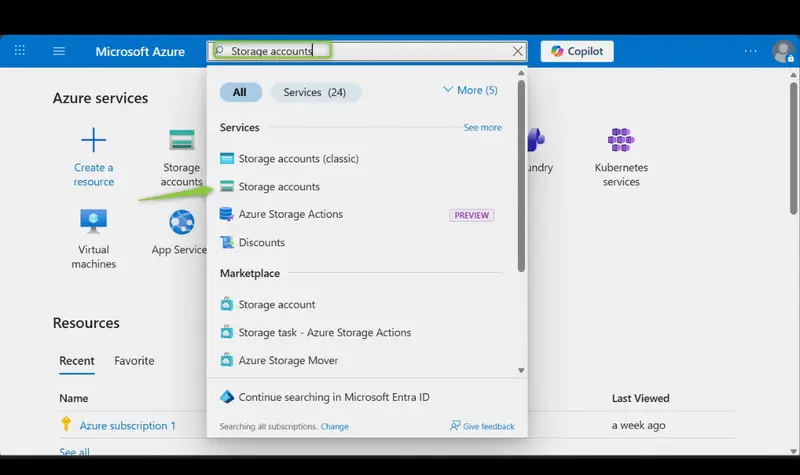
  1. In the portal, search for and select Storage accounts.

storage account
2. Select + Create.

+ Create
3. For Resource group, select New, provide a name, and select OK.

Create new
4. Set the Storage account name to publicwebsite (ensure uniqueness by adding an identifier).

Storage account name
5. Accept default settings for all other options.
6. Select Review + Create, then Create.

Review +Create
7. Wait for the deployment to complete, then select Go to resource.

Go to resource

2.Enable High Availability

Objective:

Ensure the storage account remains accessible during regional outages.

Steps:

  1. In the storage account, navigate to the Data management → Redundancy blade.

Data Management

Redundancy blade
2. Select Read-access Geo-redundant storage (RA-GRS).

RA-GRS
3. Review the primary and secondary location information.

Review

Note: RA-GRS replicates data to a secondary region, providing read access if the primary region becomes unavailable.

3.Enable Anonymous Public Access

Objective:

Allow website content to be accessed by users without authentication.

Steps:

1.In the storage account, go to Settings → Configuration.

2.Enable the Allow blob anonymous access setting.

enable blob anonymous settings

3.Save your changes.

save changes

Use case: This setting is essential for serving website files such as HTML, CSS, images, and documents to all users.

4.Create a Blob Storage Container with Anonymous Read Access

Objective:

Organize website assets (images, documents) in a dedicated container and allow public access without requiring authentication.

Steps:

1.In your storage account, go to Data storage → Containers.

Data storage

2.Select + Container.

+ container

3.Set the container name to public and select Create.

  • create container

4.Configure anonymous read access:

  • Open the newly created container.

public container

  • On the Overview blade, select Change access level.

change access level

  • Set Public access level to Blob (anonymous read access for blobs only).
  • Select OK.

5.Testing Uploads and Access:

  • Upload a test file to the public container by selecting the public container created

Public container created

  • Select Upload, browse to a file (image or text), and select Upload.

select upload

  • Refresh the container and confirm the file is uploaded.

uploaded image

6.Test public access:

  • Select the uploaded file, copy the URL from the Overview tab, and open it in a browser.

Uploaded image

Copy URL

  • Images should display directly; other file types may be downloaded.

5.Configure Soft Delete

Objective:

Protect against accidental deletions by retaining deleted files for a specified period.

Steps:

1.In the storage account, go to Overview → Properties → Blob service → Blob soft delete.

Overview section

properties/blob soft delete section

2.Enable Soft delete for blobs and set Keep deleted blobs for 21 days.

Blob soft delete for 21days
3.Save your changes.

Saved Changes

4.Testing Soft Delete:

  • Navigate to your container and delete a file. Confirm deletion.

select delete

  • Toggle Show deleted blobs on the container Overview page.

  • Select the deleted file, click the ellipsis, and choose Undelete.

Undelete

  • Refresh the container to confirm the file has been restored.

6.Configure Blob Versioning

Objective:

Maintain historical versions of files to track changes and allow recovery.

Steps:

1.In the storage account, navigate to Overview → Properties → Blob service → Versioning.

overview

versioning

2.Enable Versioning for blobs and configure options to keep or delete previous versions as needed.
3.Save your changes.

Enable versioning

4.Testing Versioning:

  • Upload a new version of an existing file in the container (overwrite the previous file).
  • Previous versions are available under the Show deleted blobs page.
  • Experiment with restoring older versions to verify versioning functionality.

✅ Key Benefits of These Configurations
• Anonymous Public Access: Serves website files without authentication.
• Soft Delete: Protects against accidental file deletions.
• Blob Versioning: Tracks changes and enables recovery of previous file versions.
• High Availability: Ensures data remains accessible even during outages or hardware failures.

Claude Code Crash Course

The first time you look at Claude Code closely, it can feel like a box full of parts that all seem important, but not obviously related.

You see CLAUDE.md. Then rules. Then skills. Then hooks. Then subagents. Then MCP servers. Then… the list goes on. Then context management, planning before coding, verifying outputs, and avoiding letting the session turn into a mess. At first glance, it is easy to think: why are there so many pieces just to get an AI coding workflow working well?

But after spending some time with these concepts, I think the answer is actually pretty simple.

Claude Code is not one thing. It is a small operating system for AI-assisted development.

And like any good system, different parts exist for different jobs.

Start here. Claude Code needs memory, structure, and reach

A good mental model is this:

  1. CLAUDE.md and rules shape behaviour.
  2. Skills package reusable know-how.
  3. Hooks enforce automatic actions.
  4. Subagents isolate work.
  5. MCP servers connect Claude to the outside world.

That is the big picture (mainly, because there is more to it, but this is enough to get us started).

Once you see it that way, the moving parts stop feeling random. They start feeling like layers. The interesting part is not learning each feature in isolation, but understanding what problem each one solves, and what happens when you try to use the wrong one for that problem. Anthropic’s docs make that distinction pretty clear. CLAUDE.md gives persistent instructions, rules can scope those instructions more precisely, skills extend Claude with reusable playbooks, hooks provide deterministic automation, subagents work in separate contexts with their own tools and prompts, and MCP is the bridge to external tools, data sources, and APIs.

CLAUDE.md and rules. The behavioural layer

If I had to pick the first thing to set up in Claude Code, it would be this.

CLAUDE.md is where you put persistent instructions that Claude should carry into every session for a project, for your personal workflow, or even across an organisation. The docs describe it as plain markdown that Claude reads at the start of every session. They also make an important point that is easy to miss: these instructions are context, not hard enforcement. So if the file is vague, bloated, or contradictory, performance drops. Anthropic recommends keeping it specific, concise, and well-structured, with a rough target of under 200 lines per file.

That last bit matters more than it seems.

A lot of people treat instruction files like a dumping ground. They keep adding preferences, workflows, architecture notes, testing conventions, edge cases, and random reminders until the thing becomes unreadable. Then they wonder why the agent follows it inconsistently. The problem is not that the model is “bad at instructions.” The problem is that the instruction layer is carrying too much weight.

That is where rules come in.

For larger projects, Anthropic recommends organising instructions inside .claude/rules/, and those rules can even be path-specific so they only load when Claude is working in matching areas of the codebase. That means you do not need every frontend rule, testing rule, security note, and data migration convention loaded all the time. You can scope them. In other words, CLAUDE.md should define the broad operating principles of the project, while rules help keep that guidance modular and targeted.

So, if you want one simple distinction:

Use CLAUDE.md for shared default behaviour. Use rules when the project is getting too big for one instruction file to stay sharp.

Skills. The reusable playbook layer

This is where Claude Code starts getting interesting.

A skill is not just “more instructions.” A skill is a packaged capability. Anthropic defines skills around a SKILL.md file. Claude can load a skill automatically when it is relevant, or you can invoke it directly with a slash command (/) based on the skill name (/my_skill). Skills can also include frontmatter, supporting files, argument handling, restricted tool access, and even subagent execution.

That changes the way you should think about them.

A rule says, “here is how we do things around here.”

A skill says, “when this kind of task appears, here is the exact playbook to follow.”

That is a huge difference.

For example, suppose your team has a repeatable workflow for debugging flaky tests, preparing release notes, reviewing API design, or migrating components from one pattern to another. You could try to cram that into CLAUDE.md, but then every session pays the context cost whether that workflow is relevant or not. Skills solve that by staying optional and task-focused. Anthropic explicitly positions them that way in the docs and even notes that for task-specific instructions that do not need to live in context all the time, skills are the better fit.

This is one of those places where the abstraction really clicks.

A good Claude Code setup is not just about telling the model how your codebase works, but about identifying which workflows deserve to become first-class tools.

That is what skills are.

Hooks. The enforcement layer

If CLAUDE.md and skills are about guidance, hooks are about guarantees.

Anthropic describes hooks as user-defined shell commands that run at specific points in Claude Code’s lifecycle. Their wording is important here: hooks provide deterministic control. In other words, they are for the things that must happen, every time, without relying on the model to remember or choose correctly. The best practices guide reinforces the same distinction: unlike CLAUDE.md, which is advisory, hooks are deterministic and guarantee the action happens.

That makes hooks the right tool for a very specific category of problems:

  • Run formatting after edits.
  • Block writes to protected files.
  • Send a notification when Claude needs input.
  • Reinject context after compaction.
  • Audit configuration changes.

Hooks are workflow mechanics. If you try to solve these mechanics with prompts alone, you are basically hoping the model behaves. Hooks exist so you do not need hope.

This is also where a lot of AI workflows quietly become trustworthy. Not because the model got smarter, but because some parts of the workflow stopped depending on the model entirely.

That is a pattern worth paying attention to.

The more a task sounds like “always do X when Y happens,” the more likely it belongs in a hook, not in a prompt.

Subagents. The isolation layer

Subagents are one of the clearest signs that Claude Code is built for agentic work, not just chat.

Anthropic describes subagents as specialised AI assistants that run in their own context window, with their own system prompt, tool access, and permissions. Claude can delegate work to them when a task matches the subagent’s description, and the subagent works independently before returning the result. The docs also point out why this matters: subagents preserve context, enforce constraints, specialise behaviour, and can route work to different models.

In long coding sessions, context gets polluted fast. Research, false starts, logs, file reads, debugging dead ends, and exploratory thoughts all pile into the same conversation. Anthropic’s best practices page repeatedly emphasises that context is the most important resource to manage, because performance degrades as the context window fills.

Subagents are how you stop every task from becoming everyone’s problem:

  • Need a security pass across many files? Use a security reviewer subagent.
  • Need research on a subsystem before implementation? Delegate it.
  • Need a focused investigation that should not clutter the main thread? Subagent.

I think this is one of the most underrated shifts in AI coding workflows. The question is no longer just “what should the model do?” It is also “which context should do it?”

That is a different level of workflow design.

MCP servers. The reach layer

Without MCP, Claude Code is mostly limited to the local environment and whatever tools it already has access to. With MCP, it can reach out.

Anthropic describes MCP, the Model Context Protocol, as an open standard that lets Claude Code connect to external tools and data sources through MCP servers. Their examples include issue trackers, monitoring platforms, databases, design tools, and workflow automation systems. They also note an important security warning: third-party MCP servers are not universally verified, and untrusted servers can introduce prompt injection or other risks.

This is where Claude Code stops being “an assistant in my repo” and starts becoming “an agent in my workflow.” That sounds exciting, and it is. But it also changes the stakes.

Once Claude can read tickets, inspect production signals, query a database, read Figma, or draft emails, the design problem becomes larger than coding. You are now designing an operational system. Permissions matter. Trust boundaries matter. Server choice matters. Tool access matters.

So while MCP is easily the most expansive capability in the stack, it is also the one that benefits most from restraint.

Just because Claude can connect to everything does not mean it should.

How these parts fit together in practice

Here is the cleanest way I can describe the whole stack:

  • CLAUDE.md tells Claude how to behave by default.
  • Rules narrow that guidance by topic or path.
  • Skills package repeatable expertise or workflows.
  • Hooks automate mandatory actions.
  • Subagents keep big or noisy tasks isolated.
  • MCP servers connect Claude to outside systems.

A practical workflow might look like this:

Your CLAUDE.md defines coding standards, project conventions, and preferred commands. A rule file adds stricter guidance for the /api directory. A skill gives Claude your internal release checklist. A hook runs linting after edits and blocks writes to a protected migration folder. A subagent handles security review in its own context. MCP connects Claude to GitHub, Jira, Sentry, and your database.

At that point, Claude Code is no longer just reacting to prompts, but operating inside a designed environment. And I think that is the real lesson here.

The quality of the workflow does not come from one magical feature. It comes from putting the right responsibility in the right layer.

Best practices that actually matter

Anthropic’s best practices page covers a lot, but a few ideas stand out because they connect directly to all the moving parts above.

First, give Claude a way to verify its work. Tests, screenshots, and expected outputs dramatically improve results because Claude can check itself instead of making you the only feedback loop.

Second, explore first, then plan, then code. Anthropic recommends separating research and planning from implementation, especially for tasks that touch multiple files or unfamiliar areas. That maps nicely to plan mode, but also to skills and subagents when you want a more structured workflow.

Third, provide specific context. Reference files, constraints, patterns, and symptoms. Claude can infer a lot, but it cannot read your mind (yet 😅).

And finally, manage context aggressively. Use /clear between unrelated tasks and avoid stuffing persistent instructions with everything under the sun.

Most of Claude Code’s “moving parts” are really context management tools in disguise.

Closing thoughts

When people first look at Claude Code, they often ask which feature matters most. I think that is the wrong question.

The better question is: what kind of problem am I trying to solve?

  • If the problem is persistent guidance, reach for CLAUDE.md and rules.
  • If the problem is reusable know how, reach for skills.
  • If the problem is guaranteed automation, reach for hooks.
  • If the problem is isolation and focus, reach for subagents.
  • If the problem is external connectivity, reach for MCP.

That is when the system starts making sense.

Claude Code does not become powerful because it has many parts. It becomes powerful when each part has a clear job. And honestly, that is probably the deeper pattern behind good AI workflows in general. Not more prompts. Not more cleverness. Better boundaries.

Practical takeaway:

  • Start with a small, sharp CLAUDE.md
  • Add rules only when the project needs more structure
  • Turn repeated workflows into skills
  • Use hooks for anything that must happen every time
  • Use subagents to protect context
  • Add MCP carefully, with trust and permissions in mind

Which part of Claude Code feels most useful to you right now: rules, skills, hooks, subagents, or MCP servers, and why?

Building an Accessible Toast Notification System in React

Toast notifications are often implemented as simple UI feedback components, but making them accessible requires additional considerations. In this implementation, the focus was not just on functionality but also on ensuring the component works well for screen reader users, keyboard users, and assistive technologies.

Accessibility Goals

The toast system was designed with the following accessibility goals:

  • Notifications should be announced to screen readers
  • Users should have enough time to read the message
  • Keyboard users should get the same behavior as mouse users
  • Users should be able to manually dismiss notifications

Screen Reader Announcements

To make sure assistive technologies announce notifications automatically, the toast container is implemented as a live region.

This tells screen readers:

  • role=”status” → This region contains status updates.
  • aria-live=”polite” → Announce updates when the user is idle.
  • aria-atomic=”true” → Read the entire notification message.

When a new toast is added, screen readers automatically announce the message without interrupting the user’s current task.

Pause on Interaction

Auto-dismissing notifications can be problematic if users don’t have enough time to read them. To address this, the toast timer pauses when the user interacts with the notification.

onMouseEnter → pause timer
onMouseLeave → resume timer
onFocus → pause timer
onBlur → resume timer

Supporting both hover and focus ensures the behavior works for:

  • Mouse users
  • Keyboard users navigating with the tab key

Accessible Dismiss Button

Each toast includes a dismiss button so users can remove notifications manually.

X

The aria-label ensures screen readers clearly communicate the purpose of the button, even though the visible content is just an “X”.

Non-Disruptive Notifications

Another important accessibility consideration is not stealing focus when a toast appears.

This implementation ensures that:

  • Notifications appear visually
  • Screen readers announce them
  • The user’s current focus remains unchanged

This prevents interruptions while users are typing or navigating through the interface.

Supporting Multiple Notifications

The system also supports stacked toasts, allowing multiple notifications to appear without overlapping content. A maximum limit prevents excessive notifications from overwhelming users.

Why Accessibility Matters Here

Toast notifications may seem small, but poorly implemented ones can create problems for assistive technology users. By incorporating:

ARIA live regions
keyboard interaction support
pause-on-interaction behavior
accessible controls

the component ensures notifications remain usable and understandable for all users.

Accessibility often comes down to small decisions in implementation, and even simple components like toast notifications can benefit from thoughtful design.